Car Frame Repair in Phoenix, AZ: Structural Integrity and Safety
Car Frame Repair in Phoenix, AZ: Structural Integrity and Safety
Why Frame Damage Is More Serious Than It Looks
You’re pulling out of a parking lot near Desert Ridge Marketplace and someone clips your front quarter panel hard enough to crumple the metal. The outside looks rough, but you figure it’s cosmetic. You’ll get it straightened, repainted, and be back on the road. What a lot of Phoenix drivers don’t realize is that the visible damage is often just the beginning.
The frame is your vehicle’s skeleton. Every system attached to your car, including suspension, steering, engine mounts, and safety crumple zones, depends on that skeleton holding the correct geometry. When a collision bends or twists the frame, those systems no longer work the way they were engineered to work. The car might drive, but it’s not safe.
Frame damage is not cosmetic body damage. A dented door panel or a cracked bumper cover affects how your vehicle looks. A bent frame affects how your vehicle behaves in the next crash, and that distinction matters enormously. Many drivers skip proper car frame repair because the car still starts and steers. That’s a mistake we see the consequences of regularly.
Here’s something the industry doesn’t say loudly enough: a vehicle with unrepaired frame damage can actually perform worse in a subsequent collision than one that was properly restored. The Insurance Institute for Highway Safety has documented how structural integrity directly affects crash test outcomes. A compromised frame doesn’t absorb and redirect impact energy the way manufacturers designed it to. It transfers that energy directly to occupants instead.
Frame issues also throw off wheel alignment in ways that accelerate tire wear and strain steering components. Drivers often spend money chasing alignment problems without realizing the frame itself is the source.
Not every collision causes frame damage, but any impact that’s significant enough to deform metal around the wheel wells, firewall, or rocker panels warrants a proper structural inspection. Eyeballing it from the driveway isn’t enough. A qualified shop uses measuring systems to compare your vehicle’s geometry against manufacturer specifications.
At Brad’s Deer Valley Collision, we’ve been doing this work in Phoenix, AZ since 1985. We’ve seen what happens when frame damage gets ignored or patched over quickly. Walk in anytime for an inspection, or reach out to schedule an assessment before the problem compounds.
Types of Frame Damage and What They Mean for Your Vehicle
Not all frame damage is the same. A hard side-impact is a completely different problem than a front-end collision, and treating them the same way is one of the fastest ways a repair can go wrong. Before you commit to any shop for car frame repair in Phoenix, AZ, you should understand what type of damage you’re actually dealing with.
Unibody Damage
Most modern vehicles use a unibody design, where the frame and body are a single welded structure. There’s no separate ladder frame underneath. That means even a moderate collision can send stress through the entire vehicle, warping sections far from the actual impact point. A front-end hit near Camelback Mountain Freeway might deform a rocker panel behind the door. You’d never guess it without a proper measurement check on a frame rack.
Unibody repairs require precise computerized measuring. Guessing is not acceptable here.
Ladder Frame Damage
Trucks and larger SUVs typically use a ladder frame, a separate steel rail structure that sits beneath the body. These frames are heavier and more visible, but they can still bend, crack, or twist under significant impact. A bent ladder frame rail changes how the entire vehicle sits, affects suspension geometry, and throws alignment completely off. Driving on a bent ladder frame causes uneven tire wear at minimum, and at worst, unpredictable handling at highway speeds.
Hidden Structural Damage
This is the category most people underestimate. A vehicle can look repaired on the outside and still have compromised structural sections underneath. Crumple zones that absorbed impact but were never fully restored, weakened welds, or hairline cracks in high-stress areas all fall here. According to the Insurance Institute for Highway Safety, structural integrity directly affects crash protection ratings. A vehicle with hidden damage may fail to protect occupants the way it was designed to.
Our honest professional opinion: a visual inspection alone is never enough after a significant collision. We’ve seen vehicles come into our Phoenix shop looking cosmetically clean but measuring significantly out of spec on the frame rack. The only way to know what you’re dealing with is a thorough diagnostic check from a shop with the right equipment and the experience to interpret what they find. Brad’s Deer Valley Collision has been doing exactly that since 1985.
The Frame Repair Process: What Happens in Our Phoenix Shop
Most shops underestimate how long a proper assessment takes. Before a single hydraulic ram touches the frame, there’s a significant amount of diagnostic work that has to happen first. Skipping that step is where corners get cut and problems get missed.
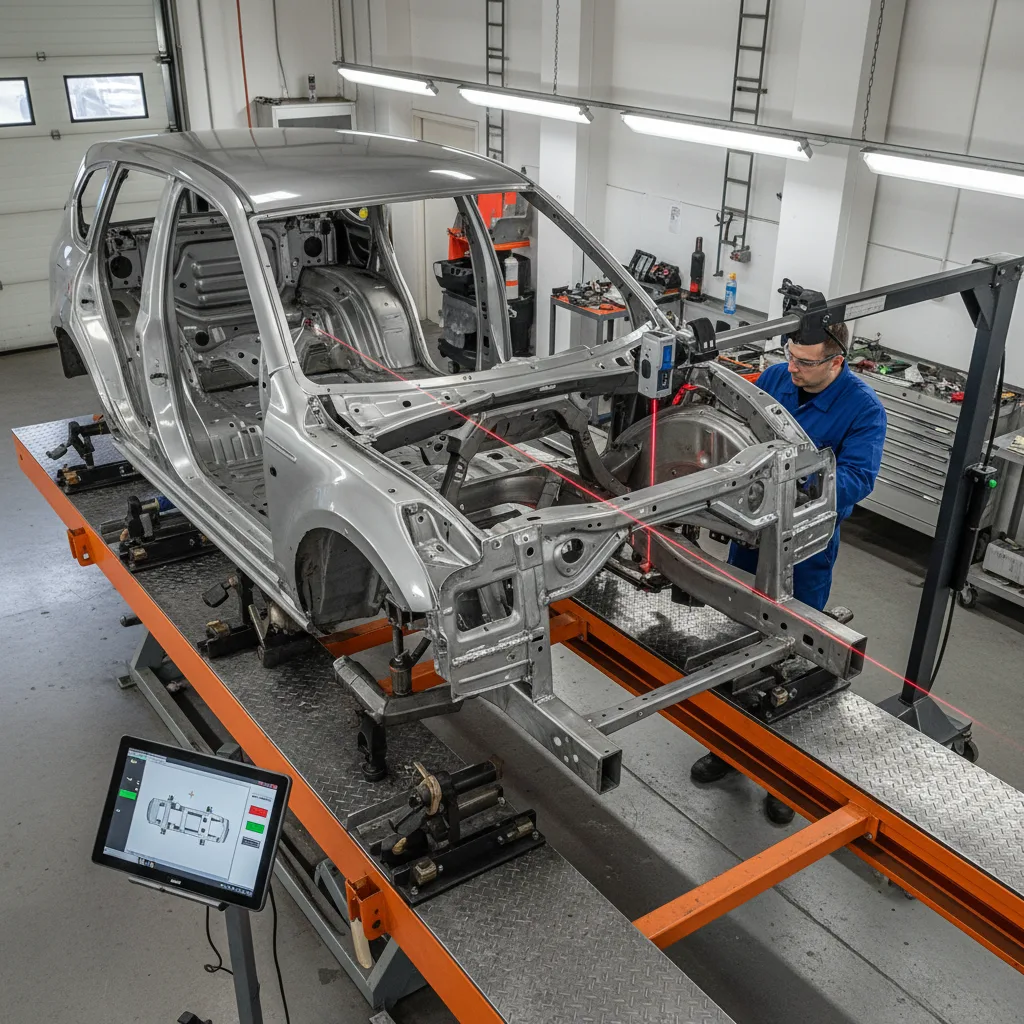
At Brad’s Deer Valley Collision, car frame repair starts with a full structural measurement using computerized three-dimensional measuring systems. We map the vehicle’s actual dimensions against manufacturer specifications to identify every point of deviation, not just the obvious ones. Phoenix’s roads put real stress on vehicles over time, and sometimes a collision reveals pre-existing misalignment that also needs to be addressed.
Step-by-Step: How We Approach Each Repair
Once the measurement data is in hand, our I-CAR certified technicians develop a repair plan specific to that vehicle. Generic approaches don’t work here. A unibody sedan has different structural tolerances than a truck frame, and the repair process has to reflect that.
The straightening phase uses frame-pulling equipment that applies controlled, measured force to return bent sections to factory specifications. This isn’t guesswork. Every pull is checked against the measurement baseline in real time. If a section has sustained metal fatigue beyond what straightening can correct, we replace it rather than force a repair that won’t hold.
After straightening, we run a full alignment verification. This is a step some shops treat as optional. We don’t. A frame that measures correctly on the bench can still produce handling problems if the suspension and alignment aren’t recalibrated to match.
Modern vehicles also require ADAS recalibration after structural repairs. Lane-keeping assist, automatic emergency braking, and backup cameras are all calibrated to a specific frame geometry. Change the geometry without recalibrating the sensors, and those systems won’t function the way they should. Many smaller shops in Phoenix still don’t have the equipment to handle this in-house.
Final Inspection Before the Car Leaves
Every car frame repair we complete goes through a final safety inspection before we contact the customer. We check welds, measure again, verify alignment numbers, and confirm all safety systems are responding correctly. Only then does the vehicle move to paint and finish work.
We’ve been doing this work since 1985, and the technology has changed dramatically, but the commitment to not rushing a structural repair hasn’t. You can review our full range of services or contact us directly to schedule an assessment. Walk-ins are welcome.
Common Frame Repair Mistakes That Compromise Safety
Bad frame work doesn’t always look bad. That’s the problem. A vehicle can come out of a shop with fresh paint, straight body panels, and a frame that’s quietly wrong in ways that won’t show up until the next collision, or the next hard stop on the I-17.
The most common mistake is stopping the inspection too early. Technicians find the obvious damage, pull the frame back to spec on the measuring system, and call it done. But collision forces travel through metal in unpredictable ways. A hard front-end hit can stress the rear frame rails, the firewall, or the floor pan without leaving visible deformation. Skipping a full-vehicle scan at the end of the repair is how hidden damage gets missed entirely.
Surface Prep Gets Cut Short
Rushing surface preparation is another common failure. Bare metal that isn’t properly cleaned, primed, and sealed before welding or coating will corrode from the inside out. In Phoenix’s dry heat, that process can actually move faster than people expect because temperature cycling accelerates oxidation in any exposed metal. A shop that’s moving too fast will skip this step. The result looks fine at delivery and becomes a problem six months later.
Post-Repair Alignment and ADAS Recalibration Are Not Optional
Skipping a four-wheel alignment after car frame repair in Phoenix is one of those shortcuts that genuinely baffles us. Any frame correction changes how the suspension geometry sits. Driving without a post-repair alignment puts uneven load on tires and steering components immediately. Most customers don’t feel it right away, which is exactly why shops get away with skipping it.
Worse is failing to recalibrate advanced driver assistance systems after structural work. Lane assist, automatic emergency braking, and forward collision warning all depend on sensors calibrated to specific frame geometry. Alter that geometry and those systems give false readings.
Red flags to watch for: no written estimate, no warranty on structural repairs, and a shop that can’t explain their ADAS recalibration process. If a quote seems unusually low, ask exactly what’s included. We’ve been doing this since 1985, and a vague estimate almost always means something’s being skipped.
Choosing the Right Phoenix Auto Body Shop for Frame Work
Most people pick a shop based on location and price. That’s understandable, but for car frame repair, it’s the wrong priority order.
Frame work is structural. A shop that does excellent cosmetic repairs isn’t automatically qualified to restore chassis geometry to factory specification. The two skill sets overlap, but they’re not the same thing. Before you hand over your keys, there are specific things worth verifying.
Certifications That Actually Matter
Ask directly whether the shop holds I-CAR Gold Class certification and whether individual technicians carry ASE credentials. These aren’t just wall decorations. I-CAR Gold Class requires ongoing training, which means the team stays current with how modern vehicle structures are engineered and repaired. A shop that can’t point to active certifications is a shop you should walk away from.
Written Estimates and Warranty Coverage
Get it in writing. Every detail. Verbal commitments on frame repair are worth nothing if the alignment is off six months later and there’s no documentation to reference. A reputable shop provides a written estimate that breaks down labor, parts, and expected timelines. They also back their structural work with a clear warranty.
One piece of commonly repeated advice worth questioning: the idea that you should always get three estimates before deciding. For basic body work, sure. For serious frame damage, chasing the lowest bid is genuinely risky. A shop pricing well below the competition on structural repairs is cutting something, and you may not find out what until much later.
Technology and ADAS Recalibration
Ask whether the shop can recalibrate advanced driver assistance systems after the repair is complete. Many smaller shops still skip this step. If your vehicle has lane-keeping assist or automatic emergency braking, that’s not optional.
At Brad’s Deer Valley Collision, we’ve been doing this work in Phoenix since 1985. Our team holds I-CAR and ASE certifications, uses computer-measured frame straightening equipment, and backs every structural repair with a written warranty. Stop by or contact us to schedule an assessment and see the full range of services we provide.
Insurance, Your Rights, and Frame Repair Estimates
Your insurer does not get to choose your shop. That’s the law in Arizona, and it’s something a lot of drivers don’t realize until they’re already in a frustrating conversation with a claims adjuster pointing them toward a preferred vendor.
You have the right to take your vehicle anywhere you trust for car frame repair in Phoenix, AZ. Insurance companies run what are called Direct Repair Programs (DRPs), which are networks of shops that agree to work within insurer guidelines in exchange for referral volume. Some of those shops do excellent work. Others prioritize cycle time and cost containment over thorough repair. The program itself isn’t the problem; the problem is when customers assume they have no choice.
At Brad’s Deer Valley Collision, we work directly with insurance companies and handle the documentation, estimates, and communication on your behalf. We’ve been doing this since 1985, so navigating claims is a routine part of what we do. Visit our full services page to see the scope of what we handle.
What to Expect from a Frame Repair Estimate
Get everything in writing. A verbal estimate means nothing if the scope of damage changes after teardown, which it often does with structural work. A legitimate estimate covers labor, parts, alignment, and any ADAS recalibration that may be required after repair.
We’d also suggest getting two or three estimates before committing, especially for significant structural damage. If one number is dramatically lower than the others, ask exactly what it excludes. Unusually low bids on frame work are a red flag worth taking seriously, not a deal worth chasing.
Have questions before dropping off your vehicle? Contact us directly or stop by. Walk-ins are welcome.
Protect Your Investment: Frame Repair Warranty and Long-Term Care
Most shops bury their warranty terms in the fine print. That’s a red flag worth taking seriously.
A professionally completed car frame repair should come with a written warranty that covers the structural work, not just the paint on top of it. At Brad’s Deer Valley Collision, we back our repairs with a strong written warranty because we’re confident in the work. We’ve been doing this in Phoenix since 1985, and our reputation depends on repairs that hold up over time, not just through your next inspection.
Post-repair care matters too. After frame work, have your alignment checked at regular intervals, especially if you’re putting highway miles on the vehicle. Phoenix roads near the I-17 corridor take a toll, and a frame that’s been straightened needs to be monitored like any other structural repair.
One opinion worth sharing: a lot of drivers obsess over turnaround time and forget to ask about warranty length. Prioritize the warranty conversation. A shop confident in its work will have no hesitation answering it.
If your vehicle has been in a collision, schedule an assessment with our team or stop by. Walk-ins are welcome. You can also review our full range of services and learn more about our 40 years of local expertise serving Phoenix drivers.
Frequently Asked Questions
How do I know if my vehicle has frame damage?
There are a few things you can look for yourself. Uneven gaps between body panels, doors or the trunk that suddenly don’t open or close right, a steering wheel that pulls or sits crooked, and visible creases or bends in the frame are all red flags. That said, a lot of frame damage hides under the surface where you can’t see it. The only reliable way to know for sure is a professional inspection using laser measurement tools. Brad’s Deer Valley Collision offers free frame assessments right here in Phoenix, AZ, USA, so don’t guess when you can get a real answer.
Can a bent frame be repaired or does it need replacement?
Good news: most frames can be straightened back to factory specifications using modern hydraulic straightening equipment. Full frame replacement is actually pretty rare and only comes up in cases of severe structural failure where repair just isn’t feasible. At Brad’s Deer Valley Collision, we always look at repair first. It’s better for your vehicle’s structural integrity, and it’s more cost-effective for you. If you’re dealing with car frame repair in Phoenix, AZ, USA, you don’t automatically need a whole new frame. Come in and we’ll give you a straight answer on what your vehicle actually needs.
How long does frame repair take?
It really depends on how much damage we’re dealing with. Minor bending can be corrected in a few days, while more serious structural work can take two to three weeks. We give you an accurate time estimate upfront before any work begins, so you’re not left guessing. Throughout the repair process, Brad’s keeps Phoenix customers in the loop with text updates and photos. Car frame repair in Phoenix, AZ, USA doesn’t have to feel like your vehicle just disappears into a shop. We keep things transparent from start to finish.
Will my insurance cover frame repair?
If you carry collision coverage, frame repair is typically covered. The specifics depend on your policy, but in most cases you’re in good shape. Brad’s Deer Valley Collision works directly with insurance providers and handles all the documentation on your behalf. We’ve helped a lot of Phoenix, AZ, USA drivers navigate the claims process without the headache, and we know how to make sure your claim is documented correctly so there are no surprises. You focus on getting your vehicle back. We’ll handle the insurance side.
What certifications should I look for in a frame repair shop?
The two you want to see are I-CAR (Inter-Industry Conference on Auto Collision Repair) and ASE (Automotive Service Excellence) certifications. I-CAR means the technicians are trained specifically in collision repair and stay current on the latest techniques. ASE covers broader automotive service excellence standards. Both matter. When you’re trusting someone with car frame repair in Phoenix, AZ, USA, you want to know the people doing the work are qualified. Brad’s Deer Valley Collision holds these credentials and displays them at our shop. Stop in and you’ll see them yourself.
Get Your Frame Inspected by People You Can Trust in Phoenix, AZ, USA
Frame damage isn’t something to put off. It affects how your vehicle handles, how it protects you in a crash, and even how it holds its value, so the sooner you get it checked, the better off you’ll be. At Brad’s Deer Valley Collision, we’ve been helping Phoenix drivers since 1985 with honest assessments, written estimates, and direct insurance coordination to make the whole process as straightforward as possible.
Stop by our shop for a professional frame inspection, or give us a call today. We welcome walk-ins, offer loaner cars, and we’re easy to find for anyone in the Phoenix area. See what our customers are saying on Google and find out why so many local drivers keep coming back to Brad’s Deer Valley Collision when it matters most.