Auto Body Shop for Business Fleets in Phoenix, AZ: Professional Collision Solutions
Auto Body Shop for Business Fleets in Phoenix, AZ: Professional Collision Solutions
Why Phoenix Businesses Choose Dedicated Fleet Collision Partners
Picture this: it’s 6:45 a.m. on a Tuesday, and your driver calls in to report that one of your delivery vans got clipped in a parking lot off Deer Valley Road overnight. You’ve got three scheduled routes starting in two hours, no backup vehicle, and zero clarity on how long the repair will take. That’s not a hypothetical. That’s a conversation we’ve had with Phoenix business owners more times than we can count.
Downtime costs real money.
Most fleet managers focus on the repair invoice, and that instinct is understandable. But the repair bill is rarely the biggest hit your business takes after a collision. A grounded vehicle means missed deliveries, rescheduled appointments, scrambled logistics, and in some cases, contract penalties. Federal Motor Carrier Safety Administration data consistently shows that commercial vehicle downtime carries operational costs that dwarf the physical repair expense itself. The repair is the easy part to quantify. Lost productivity is where the real damage adds up.
That’s why more Phoenix businesses are moving away from the “find whoever’s available” approach and building a standing relationship with a single, reliable auto body shop for business fleets. Having a shop that already knows your vehicles, your insurance contacts, and your scheduling pressures changes the dynamic entirely. You’re not starting from scratch every time something happens.
We’d push back a little on the common advice to always shop around and get three estimates for every fleet repair. For a one-time personal vehicle repair, yes, absolutely do that. For commercial fleets, constantly rotating shops introduces inconsistency in parts sourcing, documentation, and repair standards. A long-term partnership with a shop that has a proven track record matters more than chasing the occasional lower bid.
At Brad’s Deer Valley Collision, we’ve been working with Phoenix businesses since 1985. That’s nearly four decades of handling commercial vehicle repairs across industries, from contractors running pickups to service companies with full vans. Our team understands what fleet operators actually need: honest timelines, accurate estimates, and a repair done right the first time.
If your business operates vehicles on Phoenix roads, you need a collision partner who treats your fleet with the same urgency you do. We’re that shop. Learn more about who we are before your next incident forces the decision for you.
Fleet Damage Assessment & Accurate Estimates: The Foundation of Smart Repair
Get the estimate wrong, and everything else falls apart.
Fleet managers in Phoenix, AZ deal with tight budgets and tighter schedules. The last thing you need is a repair bill that doubles halfway through the job because a tech missed hidden frame damage during the initial walk-around. That’s not just frustrating, it’s a sign of sloppy intake work, and it happens more often than most shops will admit.
A proper damage assessment goes well beneath the surface. A crushed rear corner on a delivery vehicle might look like a simple bumper replacement, but the impact force can travel into the frame rails, compromise the trunk floor structure, and throw the rear suspension geometry out of alignment. At Brad’s Deer Valley Collision, our technicians use computerized measuring systems to catch structural displacement that a visual inspection would miss entirely. If there’s frame damage hiding under cosmetic damage, we find it before we write the estimate, not after we’ve already torn into the vehicle.
Here’s our honest take on something the industry gets wrong: a lot of shops hand fleet managers a one-page quote with vague line items and call it an estimate. That protects the shop, not your budget. A written estimate worth trusting should include:
-
Itemized parts list with OEM or aftermarket designation clearly noted
-
Labor hours broken down by repair category
-
Paint and materials costs listed separately
-
Any supplemental conditions or potential hidden damage disclosures
-
Warranty terms spelled out in writing
Anything less than that and you’re guessing at the final number. For a single vehicle, that’s annoying. For a fleet of five or ten units, it can wreck your monthly operating budget.
As a dedicated auto body shop for business fleets with roots in Phoenix going back to 1985, we’ve built our intake process around giving fleet operators a clear picture before any work begins. No surprises. No vague language. Just a straight answer so you can make a confident call.
Minimizing Operational Downtime: Multi-Vehicle Scheduling & Turnaround
Here’s something fleet managers figure out fast: the repair itself isn’t always the most expensive part of a collision. The downtime is. Every day a vehicle sits in a bay is a day a route doesn’t run, a delivery gets delayed, or a crew member sits idle. That’s a real cost that never shows up on the repair invoice.
Downtime compounds quickly.
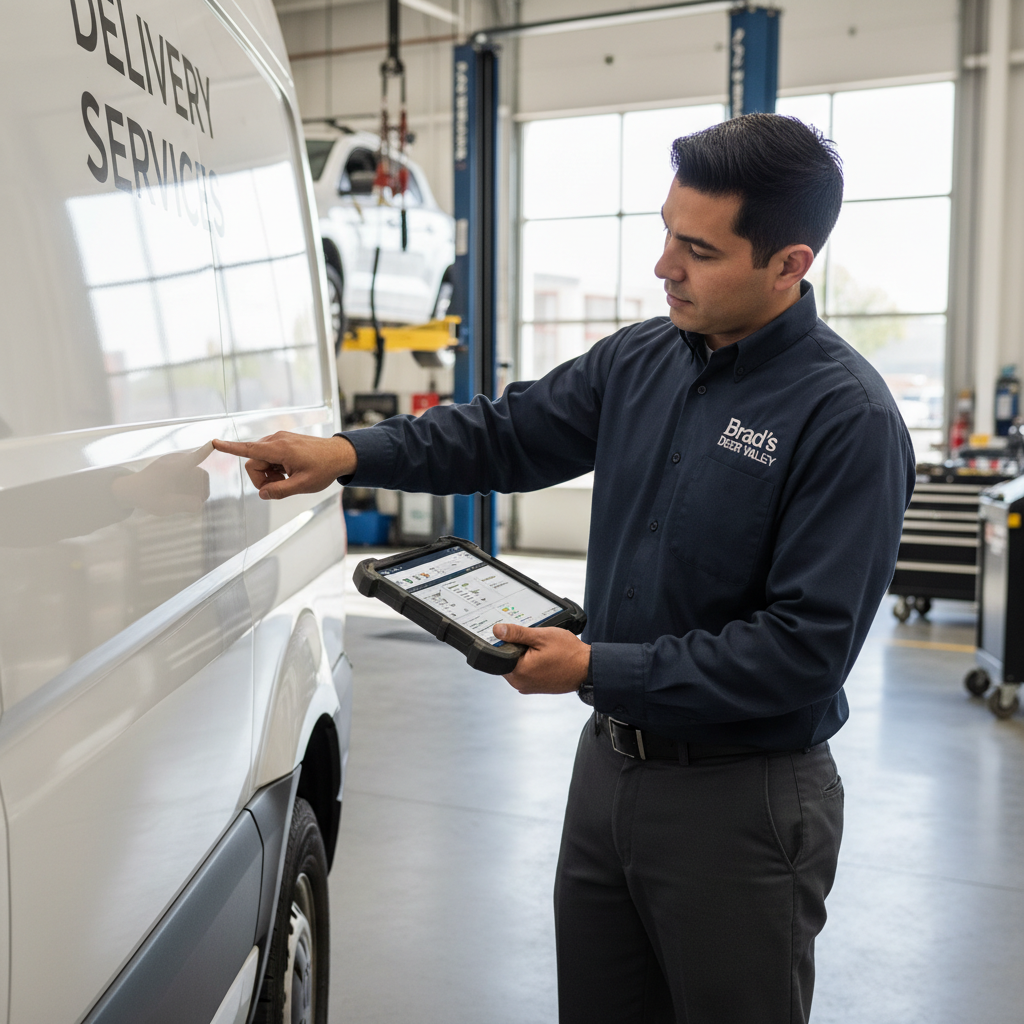
At Brad’s Deer Valley Collision, we’ve structured our workflow specifically around fleet volume. That means we can intake multiple vehicles at once, assign dedicated technicians to priority units, and coordinate staging so that your most critical vehicles move to the front of the queue. We don’t just take in whatever walks through the door and work chronologically. Fleet repair requires a smarter approach than that.
Coordinating Multiple Vehicles Without Chaos
A lot of shops will tell you they handle fleet work, and then treat your five vehicles like five separate walk-in customers. That’s the wrong model. When you’re working with a dedicated auto body shop for business fleets, scheduling has to be proactive, not reactive. We communicate directly with fleet managers to understand which units are highest priority, what your operational calendar looks like, and where we can create realistic turnaround commitments you can actually plan around.
We also work directly with insurance adjusters to cut the back-and-forth that bogs down approval timelines. Faster approvals mean faster start dates. That matters enormously when you’ve got three vehicles waiting on supplemental authorization before a single repair can begin.
Honest turnaround estimates matter more than optimistic ones. We’d rather give you a real completion window than promise a fast turnaround and miss it. Phoenix businesses rely on predictability, and we’ve been doing this since 1985. We know what realistic looks like.
Reducing shop time starts with a solid plan from day one. That’s exactly how we approach every fleet account we serve in Phoenix, AZ.
OEM Parts, Aftermarket Options & Warranty: What Every Fleet Manager Should Know
Parts decisions matter more than most people realize. And in a fleet context, the wrong call on parts can multiply across dozens of vehicles over time, creating compounding liability and safety exposure that no budget savings can justify.
OEM versus aftermarket is a debate that comes up constantly in this industry. Here’s our honest take after nearly four decades as an auto body shop for business fleets in Phoenix, AZ: aftermarket parts aren’t automatically bad, but they’re also not automatically equivalent to OEM. The difference depends heavily on the part type, the vehicle make, and who’s installing it.
Where OEM Parts Earn Their Price Tag
Structural components are not the place to save money. Bumper reinforcement bars, door beams, and frame-adjacent panels are engineered to specific crash-absorption tolerances by the manufacturer. An aftermarket version that’s 15% cheaper may also be 15% less precise in how it performs during a secondary impact. For a fleet vehicle carrying employees or cargo on Phoenix highways every day, that’s a risk worth understanding clearly before signing off on any repair order.
Safety-system-adjacent parts carry the same concern. If a component sits near sensors, cameras, or structural mounting points for ADAS technology, OEM fitment is almost always the right call.
Where Aftermarket Parts Make Sense
Non-structural cosmetic components, body panels on older fleet units, and certain trim pieces are reasonable candidates for quality aftermarket alternatives. The key word there is quality. We vet the brands we use. Not every part that comes in a box marked “fits your vehicle” actually fits your vehicle well enough for fleet service demands.
Ask About the Warranty Before You Sign Anything
A shop’s warranty tells you a lot about their confidence in their own work. At Brad’s Deer Valley Collision, we back our repairs with a written warranty covering both parts and labor. Fleet managers should ask every shop they’re evaluating the same questions: Is the warranty written? Does it cover the labor if a part fails? What’s the claim process?
Verbal assurances don’t protect your fleet. Get it in writing, every time. The Federal Trade Commission provides clear consumer guidance on warranty rights that applies to commercial vehicle repairs as well.
Cutting corners on parts to hit a lower invoice number is a short-term fix that tends to show up as a long-term problem. Don’t let budget pressure push a parts decision that compromises your drivers or your liability exposure.
Insurance Direct Repair Programs & Streamlined Claims Processing
Fleet managers who’ve handled commercial claims before know this pattern well: the insurer recommends a shop, you go there, and three weeks later you’re still chasing paperwork. It doesn’t have to work that way.
At Brad’s Deer Valley Collision, we participate in direct repair programs (DRPs) with major commercial insurers. That relationship matters because it cuts out a significant layer of back-and-forth. Pre-approved repair protocols, established billing channels, and direct adjuster communication all move your claim faster than a shop working outside those agreements.
That said, here’s an opinion that might surprise you: DRP status isn’t a magic fix, and some shops hide behind it to avoid giving clients a clear accounting of costs. We don’t operate that way. Every fleet client gets a written, itemized estimate before any work begins. That documentation protects your company if an insurer questions repair scope or tries to push back on costs.
What to Expect From the Claims Process
Transparency matters here. When your driver files a claim after a collision in Phoenix, our team works directly with your insurer to confirm coverage, document damage accurately, and submit what’s needed to keep approvals moving. You’re not left making phone calls between your adjuster and the shop.
A few things fleet managers should always verify with any shop handling commercial claims:
-
Written repair authorization before any work starts
-
Clear communication about OEM versus insurer-approved parts
-
Documented supplement requests if hidden damage is found mid-repair
-
Final invoice that matches the approved estimate
Remember, you have the legal right to choose your own repair facility regardless of what your insurer suggests. As an established auto body shop for business fleets in Phoenix, AZ, we’ve built relationships with insurers that work in your favor, not against your timeline.
Safety Systems, ADAS Recalibration & Post-Repair Inspection Standards
Most shops skip this step. That’s a serious problem.
Modern commercial vehicles, even basic work vans and light-duty trucks, are loaded with safety technology: automatic emergency braking, lane departure warnings, blind-spot monitoring, adaptive cruise control. These systems rely on precisely calibrated sensors and cameras. Hit a curb hard enough or take a significant bumper impact, and that calibration gets knocked out of spec, even if the damage looks minor from the outside.
A lot of smaller shops don’t have the equipment to recalibrate Advanced Driver Assistance Systems (ADAS). They’ll do the bodywork, hand you back the keys, and never mention it. That’s not just an oversight. It’s a liability exposure for your business. If a driver relies on automatic braking that isn’t functioning correctly and causes an accident, that’s on the vehicle’s repair record, and potentially on you.
At Brad’s Deer Valley Collision, we’ve invested in the technology to handle ADAS recalibration correctly, as part of the repair, not as an afterthought. Our technicians hold I-CAR and ASE certifications, and we stay current on manufacturer-specific recalibration requirements because those specs differ significantly across makes and models. You can review our full collision repair capabilities to see the scope of what we handle in-house.
What Our Post-Repair Inspection Covers
-
Structural alignment verification after any frame or unibody repair
-
ADAS sensor and camera calibration checks
-
Suspension and steering geometry review
-
Paint finish inspection under controlled lighting
-
Full operational check before vehicle release
We’ve been doing this in Phoenix, AZ since 1985. One thing that hasn’t changed: cutting corners on the final inspection always costs more later. For fleet operators running vehicles daily, a missed alignment issue or an uncalibrated safety sensor doesn’t stay hidden for long.
Every vehicle we repair as an auto body shop for business fleets goes through this full process before it leaves our facility. No exceptions.
Building Long-Term Fleet Partnerships: Communication, Reliability & Results
Fleet managers don’t stay loyal to a shop because of a single good repair. They stay because the shop makes their job easier, consistently, over time.
That’s the standard we hold ourselves to at Brad’s Deer Valley Collision. We’ve been serving Phoenix, AZ businesses since 1985, and one thing hasn’t changed: the shops that earn long-term fleet accounts are the ones that communicate proactively, not reactively. You shouldn’t have to chase us for a status update. We push that information to you.
Here’s what that looks like in practice. After drop-off, your fleet coordinator gets a written repair summary with an estimated completion window. As work progresses, you get updates, not silence. If something changes, you hear it from us first, before it affects your schedule.
We also know that commercial vehicles don’t always go down during business hours. Our after-hours drop-off option means a vehicle that gets damaged at the end of a shift can be in our bay overnight, not sitting in your lot losing another day. For fleets running tight, that matters.
Some shops treat warranty coverage as fine print. We disagree with that approach. Every repair comes with documented warranty terms, in writing, so your company has a clear record if questions come up later. That kind of accountability builds trust faster than any sales pitch.
If you’re ready to work with a dedicated auto body shop for business fleets in Phoenix, AZ, explore our fleet repair services or contact us directly to discuss your fleet’s needs.
Frequently Asked Questions
How long does it typically take to repair a fleet vehicle at Brad’s Deer Valley Collision?
Turnaround time depends on the severity of the damage, parts availability, and how busy the shop is at the time. Minor repairs like bumper dents or fender damage usually take 3 to 7 days. Major structural repairs can run 2 to 4 weeks. As a dedicated auto body shop for business fleets in Phoenix, AZ, USA, we coordinate directly with your fleet schedule and your insurance company to prioritize the vehicles your operation needs most and get them back on the road fast.
Do you work directly with our commercial vehicle insurance provider?
Yes, we do. Brad’s Deer Valley Collision participates in direct repair programs (DRP) with major commercial insurers, and we work directly with insurance adjusters on your behalf. We handle the estimates, claim documentation, and back-and-forth communication so you don’t have to. This keeps approvals moving quickly and cuts down on the delays that cost your business time and money. Just let us know who your provider is when you contact us.
What’s the difference between OEM and aftermarket parts for fleet vehicles?
OEM (original equipment manufacturer) parts are made to match your vehicle’s exact original specs and come with a full manufacturer warranty. Aftermarket parts are third-party alternatives that typically cost less but can vary in fit, finish, and durability. We recommend OEM for anything safety-critical. That said, we give every fleet customer a transparent, part-by-part breakdown in their repair estimate so you can make an informed decision. You’ll know exactly what’s going into each vehicle before we start any work.
Do you offer loaner vehicles or shuttle service while our fleet vehicles are being repaired?
Yes. We offer loaner vehicles and shuttle service for fleet customers to help keep your operation running while your vehicles are in the shop. We also accommodate after-hours drop-off for businesses that can’t afford to lose time during the work day. Availability does depend on current demand, so the sooner you mention your needs when calling for a fleet repair estimate, the better we can plan around your schedule. Stop by our Phoenix, AZ, USA location and we’ll walk you through the options.
What is ADAS recalibration and why does my fleet vehicle need it after collision repair?
ADAS stands for Advanced Driver Assistance Systems, which includes features like lane assist, automatic emergency braking, and collision avoidance. After any collision repair, especially work involving the front, rear, or frame, those sensors can be knocked out of alignment and won’t function safely until they’re recalibrated. Many smaller shops don’t have the equipment or certification to do this correctly. Brad’s Deer Valley Collision has I-CAR certified technicians and the proper tools to handle ADAS recalibration, making us a reliable auto body shop for business fleets in Phoenix, AZ, USA that need complete, safe repairs.
Let’s Get Your Fleet Back on the Road
If your business runs on wheels, every day a vehicle sits in the shop is money out of your pocket. At Brad’s Deer Valley Collision, we work with fleet operators across Phoenix, AZ, USA to keep repair time short and your vehicles performing the way they should. Stop by our shop in Deer Valley or give us a call today and we’ll walk you through an honest assessment and a clear estimate, no surprises.
Contact Brad’s Deer Valley Collision now and let’s figure out the best plan for your fleet.