Professional Auto Body Paint Matching in Phoenix, AZ: Achieving Invisible Repairs
Professional Auto Body Paint Matching in Phoenix, AZ: Achieving Invisible Repairs
Why Auto Body Paint Matching Matters More Than Most People Realize
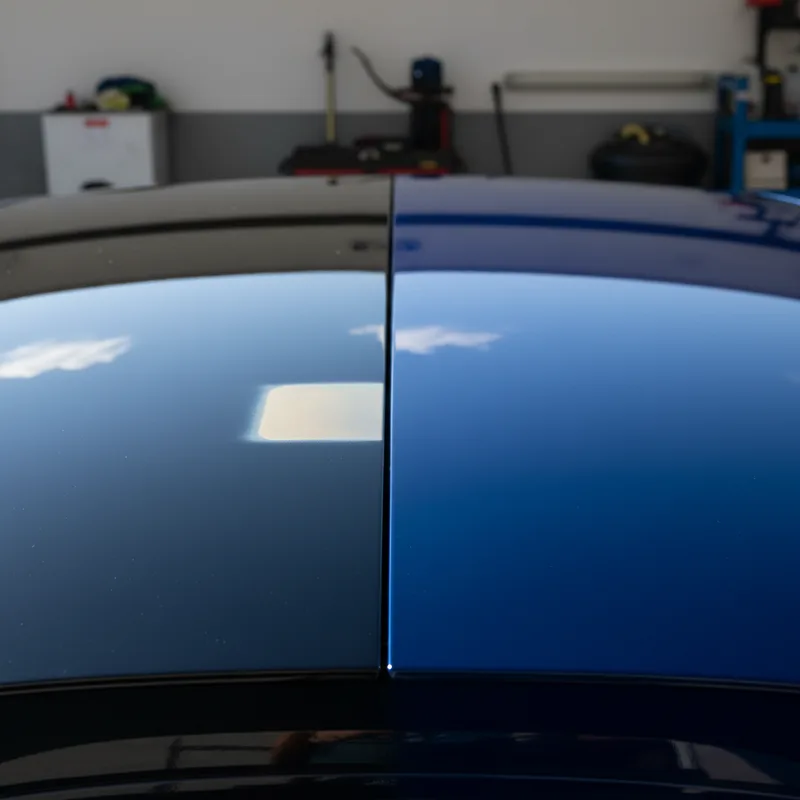
You’re backing out of a parking spot at Desert Ridge Marketplace, and another driver clips your rear quarter panel. The damage looks minor — a palm-sized scrape, some paint transfer, nothing structural. You take it to a discount shop that quotes you half the price of everyone else. Three weeks later, the repair is done, but standing in full Phoenix sunlight, there’s a patch on your car that looks like it belongs on a different vehicle. The color is close, but not right. You can see exactly where the repair ends.
That’s the consequence of poor auto body paint matching, and it’s more damaging than most car owners expect.
Resale value takes a real hit. Used car buyers and dealerships inspect for mismatched paint because it signals prior damage and substandard repairs. A visible color variance on a panel can drop your vehicle’s private-sale value by hundreds of dollars, sometimes more on newer models. What you saved upfront, you lose later.
There’s also the warranty angle. Many factory paint warranties include provisions that can be complicated by improper repairs. If a future corrosion issue traces back to a panel that was repainted without proper prep or color-matched clearcoat, you may lose coverage you were counting on. The repair that seemed cheap becomes expensive in ways you didn’t anticipate.
A lot of people assume paint matching is mostly about picking the right color code off the door jamb sticker. That’s a starting point, not a solution. Vehicle paint fades, oxidizes, and shifts over time, especially under the intense Arizona sun. A fresh coat mixed strictly to factory specs will almost always look different against your existing panels. Accurate auto body paint matching requires compensating for that real-world drift, and that takes equipment and experience, not just a code number.
At Brad’s Deer Valley Collision, we’ve been doing this work in Phoenix, AZ since 1985. We’ve seen every version of a botched paint job, and we know what separates an invisible repair from one that follows your car everywhere. The difference comes down to precision, and precision takes the right process.
The Science Behind Professional Paint Matching Technology
Most people assume paint matching is mostly guesswork, maybe an experienced eye and a color chart. It’s not. Modern auto body paint matching is driven by measurement equipment that removes human bias from the equation almost entirely.
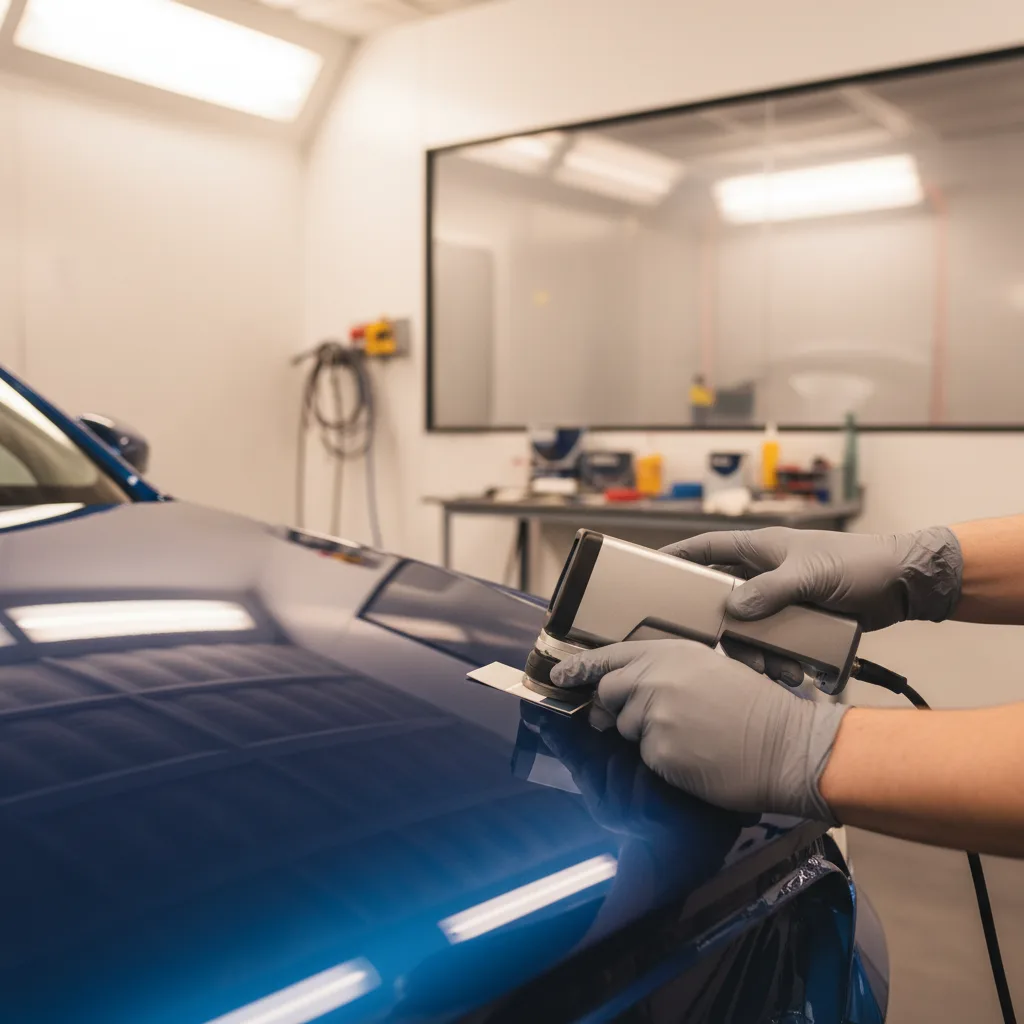
The tool at the center of this process is a spectrophotometer. It reads your vehicle’s existing finish by bouncing light off the surface at multiple angles and recording exactly how that light reflects back. The result is a precise color signature, not a general “blue” or “silver,” but a specific data profile that accounts for hue, depth, brightness, and the metallic or pearl flake behavior in the paint. Our equipment at Brad’s Deer Valley Collision takes readings in seconds and feeds that data directly into a color-matching database.
That database matters more than most people realize. Paint codes from the factory are a starting point, not a final answer. Vehicles fade in Phoenix, AZ’s intense sun. Clear coats oxidize. Two vehicles with the same factory code can look noticeably different after a few years on the road. A shop relying on the code alone will frequently miss. The spectrophotometer captures where your paint actually is today, not where it started.
Color science goes deeper than the base color.
Modern factory finishes often use three-stage or four-stage paint systems: a primer layer, a base color coat, a mid-coat for pearl or metallic effects, and a clear coat on top. Matching a single-stage solid color is relatively straightforward. Matching a tri-coat pearl finish on a 2020 vehicle that’s spent four summers baking near Camelback Mountain is a different challenge entirely. That’s where the combination of digital measurement and experienced application technique makes the difference between a patch that disappears and one that announces itself.
We’ve seen shops skip the spectrophotometer step because they’re confident in their painters’ eyes. Honestly, that confidence is misplaced. Even a skilled painter’s eye can’t reliably detect the metamerism effect, where two colors match under shop lighting but diverge completely in daylight. The equipment catches that problem before a panel goes back on the vehicle.
Brad’s has been doing this work since 1985, and the technology we use today would have seemed extraordinary back then. Our full range of paint and collision services is built around this kind of precision. If you want to see the equipment or talk through the process before committing, stop by or reach out and we’ll walk you through it.
The Five-Step Paint Matching Process at Brad’s Deer Valley Collision
Every painter eventually learns that skipping even one step in the matching process shows up in the final result. It might not show today, but it shows. Here’s exactly how we handle auto body paint matching from the moment your vehicle arrives at our Phoenix, AZ shop.
Initial Paint Condition Assessment
Before any color reading happens, we inspect the existing paint for oxidation, previous repairs, and UV fade. Phoenix’s sun is hard on clear coats, and a spectrophotometer reading taken on a compromised surface will produce a bad formula. We clean and prep the measurement area first, every time.
Spectrophotometric Color Reading
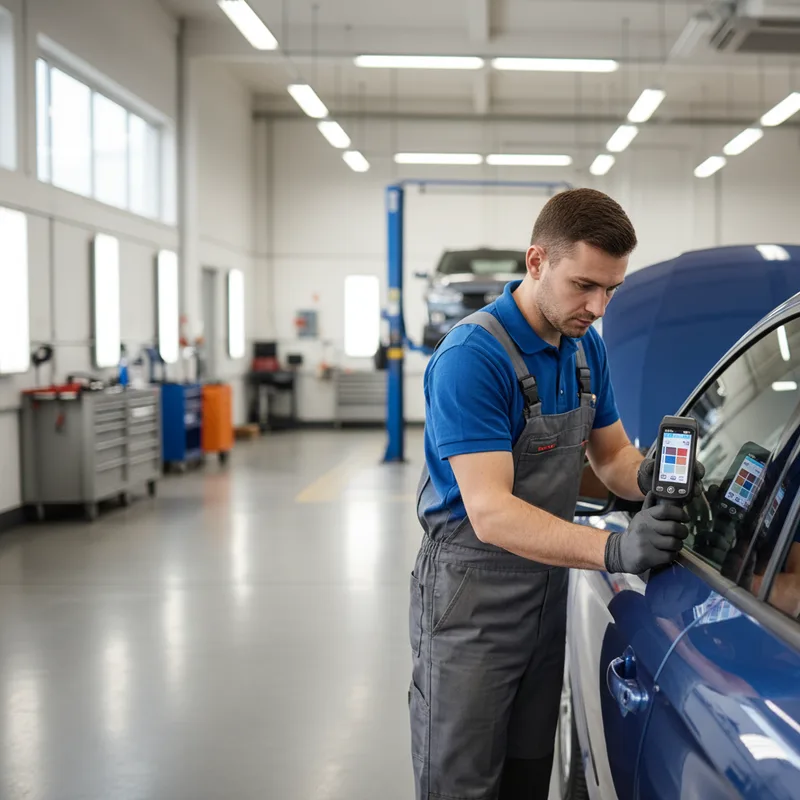
We take multiple readings across the repair panel, not just one. Paint fades unevenly, especially on horizontal surfaces that catch direct sun. Our equipment measures light reflectance at several angles to capture metallic flake orientation and pearl depth. That data goes directly into our mixing system.
Formula Retrieval and Adjustment
The OEM formula is a starting point, not the answer. Most shops treat it like the answer. We pull the factory code, then adjust based on the spectrophotometer data and the technician’s read of the car’s actual condition. Our team has been doing this in Phoenix since 1985, and that field experience matters at this stage. You can read more about our background on our about page.
Test Spray and Visual Verification
We spray a test card and evaluate it under both shop lighting and natural daylight. Color can shift dramatically between those two environments. If the test card doesn’t pass both checks, we adjust and spray again before touching your car.
Final Blend and Quality Inspection
After the repair panel is painted, we blend into adjacent panels as needed and run a final inspection. This is part of our complete auto body service process. If something looks off, it gets fixed before the car leaves.
Ready to get started? Contact us for a written estimate. Walk-ins are welcome.
Common Paint Matching Mistakes That Damage Your Vehicle’s Appearance
Bad paint work is obvious. You don’t need a trained eye to spot it in direct sunlight.
Most auto body paint matching failures aren’t random. They trace back to the same repeatable mistakes made by shops that cut corners on process or equipment. After nearly 40 years working on vehicles in Phoenix, we’ve seen every version of these errors come through our doors, usually on cars that were repaired somewhere else first.
Skipped or Rushed Surface Prep
This is the biggest one. Paint doesn’t stick properly to contaminated or improperly sanded surfaces, full stop. Shops that skip thorough cleaning, sanding, and feathering before primer application will produce paint that looks fine for a few months, then starts peeling or lifting at the edges. A lot of shops rush this step because it’s labor-intensive and not visible to the customer before pickup. That’s a problem.
Inadequate Primer and Contamination
Primer isn’t optional. It’s what bonds the topcoat to bare metal or filler, and it affects how color absorbs. Skimping on primer coats, or applying them in a dusty, poorly sealed environment, invites contamination that shows up as texture problems or color inconsistency. I-CAR training covers these standards in detail, and shops with certified technicians treat them as non-negotiable.
Rushing the Cure
Forcing a vehicle out the door before paint fully cures causes micro-cracking and premature dulling. Proper curing takes time, sometimes assisted by controlled heat in a spray booth. There’s no shortcut that produces lasting results.
Our I-CAR and ASE certified team follows a disciplined process on every repair. If you’ve got questions or concerns about a previous paint job, reach out to us directly for an honest assessment.
Phoenix Weather and Paint Matching: Why Local Expertise Matters
Paint fails faster in Phoenix than almost anywhere else in the country. That’s not an opinion; it’s something you notice after decades of inspecting finished repairs under direct desert sun.
The combination of sustained triple-digit heat, ultraviolet intensity that exceeds most U.S. cities, and single-digit humidity creates conditions that no generic shop manual accounts for. The U.S. Department of Energy recognizes the Phoenix valley as one of the highest solar radiation zones in North America. That matters directly for auto body paint matching because UV exposure degrades clear coat and base coat at an accelerated rate compared to moderate climates.
Here’s where a lot of shops get it wrong. They follow standard curing times printed on the paint manufacturer’s data sheet, which are calibrated for temperate environments. In Phoenix, those timelines need real-world adjustment. Rushing a panel out of the booth when ambient temperatures are already above 100 degrees can cause micro-stress in the clear coat before it’s fully cross-linked. The repair looks fine on pickup day. Three months later, it’s showing texture inconsistencies the customer can’t explain.
Low humidity creates a separate problem. Paint flashes off solvent faster than the chemistry expects, which affects how the metallic flakes orient themselves in the base coat. Flake orientation is everything in auto body paint matching. A misaligned flake layer shifts color appearance depending on the viewing angle, and that’s exactly the kind of mismatch that shows up at noon in a parking lot near Camelback Mountain.
We’ve been doing this work in Phoenix since 1985. Our team has adjusted spray techniques, flash times, and booth protocols specifically for desert conditions. That’s local knowledge no out-of-state training course delivers. If you want to see how we approach your specific vehicle, contact us for a no-pressure estimate.
Insurance Claims and Paint Matching: What You Need to Know
Your insurer wants to settle your claim fast. That doesn’t always mean they want to settle it right. Understanding how paint matching fits into the claims process can protect you from accepting a repair that looks wrong six months later.
Adjusters work from labor time guides and regional cost averages. They don’t always account for the extra blending work required to match factory finishes on older vehicles, or the additional material cost that precise auto body paint matching demands in Phoenix’s sun-damaged paint environment. If a shop submits a thorough, itemized estimate that includes blending adjacent panels, that’s not padding. That’s accurate work.
Know this: you have the legal right to choose your own repair shop in Arizona. Your insurer can recommend a preferred shop, but they cannot require you to use one. Steering happens. If an adjuster implies otherwise, push back.
Brad’s Deer Valley Collision participates in direct repair programs with major carriers, which means our estimates carry weight in the approval process. We’ve been doing this since 1985, and insurers recognize shops with documented quality standards. Our full range of services is built around repairs that hold up to both inspection and daylight.
A common misconception is that going with the lowest approved estimate saves you money. It rarely does. A poor color match can reduce resale value, and insurance consumers have complaint options if a claim is handled unfairly. Getting the repair done correctly the first time avoids all of that.
Get your questions answered before anything gets signed. Contact us for a written estimate you can take directly to your adjuster.
Protecting Your Investment: Paint Warranty and Long-Term Results
Paint that looks perfect on day one can still fail at six months. That’s the pattern you notice after decades in this business, and it’s almost always tied to what happened before the color ever went on the car.
At Brad’s Deer Valley Collision, every auto body paint matching job carries a written warranty on materials and workmanship. Not a verbal assurance. A document you keep. We’ve been doing this in Phoenix since 1985, and a warranty only means something when the shop is still here to honor it. We are. You can read more about our history and I-CAR and ASE credentials on our About page.
A lot of shops push post-repair ceramic coatings as the answer to everything. Honestly, they help, but they don’t fix a bad paint job underneath. Our position is that prep and application quality matter more than any aftermarket coating you add on top. Start right, and the finish holds up to Phoenix summers without needing to be rescued.
For long-term results, we recommend a few straightforward habits:
-
Hand wash rather than automatic brush washes for the first 30 days
-
Park in shade or covered structures when possible, especially midday in summer
-
Apply a quality carnauba or synthetic wax every three to four months
-
Address new chips and scratches quickly before moisture gets underneath
Professional-grade finishes outlast budget work because the foundation is built correctly. That’s the difference you’re paying for. To see the full range of services we provide, or to schedule your estimate, reach out today. Walk-ins are welcome.
Frequently Asked Questions
How long does professional paint matching and repair take?
Most auto body paint matching jobs here in Phoenix, AZ, USA take somewhere between 3 and 7 business days. That range depends on how severe the damage is, how long the primer needs to cure, and what the weather conditions are doing that week. Phoenix heat can actually work in our favor for drying times, but we don’t rush the process just to turn a car around faster.
If you’re in a tight spot, we do offer rush services. Either way, when you come into Brad’s Deer Valley Collision for your estimate, we’ll give you a written timeline so you know exactly what to expect and when you’ll have your vehicle back.
Will the repair match my car’s original paint color exactly?
Yes, it will. At Brad’s, we use a spectrophotometer to read your vehicle’s factory paint code directly off the car. That data feeds into a digital color database that lets us mix a formula matched to your specific vehicle, not just a close approximation. Once the paint cures, you genuinely can’t tell the repaired area from the original finish, whether you’re looking at it in direct Phoenix sunlight, shade, or under artificial lighting.
Do insurance companies cover professional paint matching?
Yes, insurance policies cover proper auto body paint matching as part of a standard collision repair claim. Brad’s Deer Valley Collision holds direct repair program status with major insurers, which means they’ve already pre-approved our quality standards. That removes a lot of the back-and-forth that can slow things down at other shops. You won’t have to fight over whether the repair is being done correctly. We handle the communication with your insurer directly so you don’t have to.
What’s the difference between OEM and aftermarket paint?
OEM paint (original equipment manufacturer) is formulated to match your car’s factory specifications exactly, including the sheen, texture, and durability built into the original finish. Aftermarket paint costs less but can vary in quality, and in some cases it affects how well the repair holds up over time or how closely it matches the surrounding panels. For auto body paint matching work in Phoenix, AZ, USA, we recommend OEM paint. It protects your warranty and gives you the most invisible result possible.
How do I maintain a newly painted repair in Phoenix’s heat?
Phoenix’s sun is genuinely tough on fresh paint, so the first 30 days matter a lot. Park in the shade whenever you can, hand-wash with a mild soap (skip the automated car washes for now), and don’t use any abrasive compounds or polishes on the repaired area. After 30 days, apply a UV-protective wax monthly to keep the gloss looking sharp and to protect the clear coat from fading. Following these steps will keep your auto body paint matching repair looking great for years.
Get a Free Paint Matching Estimate at Brad’s Deer Valley Collision
If your car has paint damage and you want a repair that’s truly invisible, we’d love to help. Brad’s Deer Valley Collision has been serving Phoenix, AZ, USA since 1985, and our team knows how to match your vehicle’s exact color and finish so the repair blends in perfectly. Stop by our Deer Valley location for a quick walk-in assessment, or give us a call to schedule your auto body painting service today.
We’re proud of the work we do, and you can see what our customers are saying on Google before you even come in. Call us now or visit us in person and let’s get your car looking great again.