Frame Alignment in Phoenix, AZ: Restoring Structural Safety After Impact
Frame Alignment in Phoenix, AZ: Restoring Structural Safety After Impact
Why Frame Alignment Matters More Than You Think
You’re driving home on the I-17 and somebody rear-ends you at a stoplight near Deer Valley Road. The bumper looks scuffed, the trunk closes fine, and the other driver’s insurance cuts you a check without much fuss. You take the car to a quick-fix shop, they buff out the cosmetics, and you move on. Six months later, your tires are wearing unevenly, the steering pulls left, and your automatic emergency braking is throwing warning lights. That’s not a coincidence. That’s a frame alignment problem that nobody caught.
Frame damage doesn’t always announce itself. A collision that looks minor from the outside can transfer significant force through your vehicle’s unibody or frame rails, bending or twisting structural components in ways that aren’t visible to the naked eye. Phoenix roads don’t help either. The combination of high-speed freeway driving and the occasional pothole on surface streets like Thunderbird or Cave Creek Road puts constant stress on a vehicle that’s already been knocked out of spec.
Here’s what a lot of drivers don’t realize: frame alignment directly controls how your car handles, absorbs future impacts, and keeps you in your lane. A vehicle with even a small deviation in its frame geometry won’t distribute crash energy the way the manufacturer designed it to. In a second collision, that matters enormously.
There’s a common belief that frame damage is only a concern after a serious wreck. That’s worth pushing back on. According to the Insurance Institute for Highway Safety, modern vehicles are engineered with precisely calculated crumple zones and structural load paths. Even low-speed impacts can shift those measurements enough to affect vehicle safety. The threshold for “serious” damage is much lower than most people assume.
At Brad’s Deer Valley Collision, we’ve been doing this work in Phoenix, AZ since 1985. We’ve seen what happens when frame issues get overlooked, and it’s rarely pretty. Misaligned frames cause premature suspension wear, uneven tire contact, and compromised ADAS sensor calibration, all problems that compound over time.
Frame alignment isn’t optional maintenance. It’s a structural safety issue. If your vehicle has been in any collision, even one that seemed minor, getting a proper frame inspection is the right call. Reach out to schedule an assessment and get a clear picture of where your vehicle actually stands.
The Frame Damage Diagnostic Process: How We Assess Your Vehicle
Most shops look at what they can see. We look for what the collision is hiding.
At Brad’s Deer Valley Collision, every frame damage assessment starts with a methodical inspection before any repair equipment gets touched. That’s not a formality. A vehicle that goes straight to the frame rack without a thorough diagnostic is a vehicle that gets partially fixed at best. We’ve seen that pattern play out in Phoenix, AZ long enough to know how often it ends badly for the car owner.
Visual Inspection First
The first step is a detailed walk-around by a trained technician, not an estimator with a clipboard. We’re looking at panel gaps, door alignment, suspension geometry, and any signs that the vehicle’s body has shifted relative to the frame. Even a minor rear impact can push a unibody vehicle out of spec in ways that aren’t obvious until you know where to look. Buckled floor panels, misaligned firewall components, and stress fractures near weld seams all tell a story that the outer bodywork might be covering up.
Computerized Measuring Systems
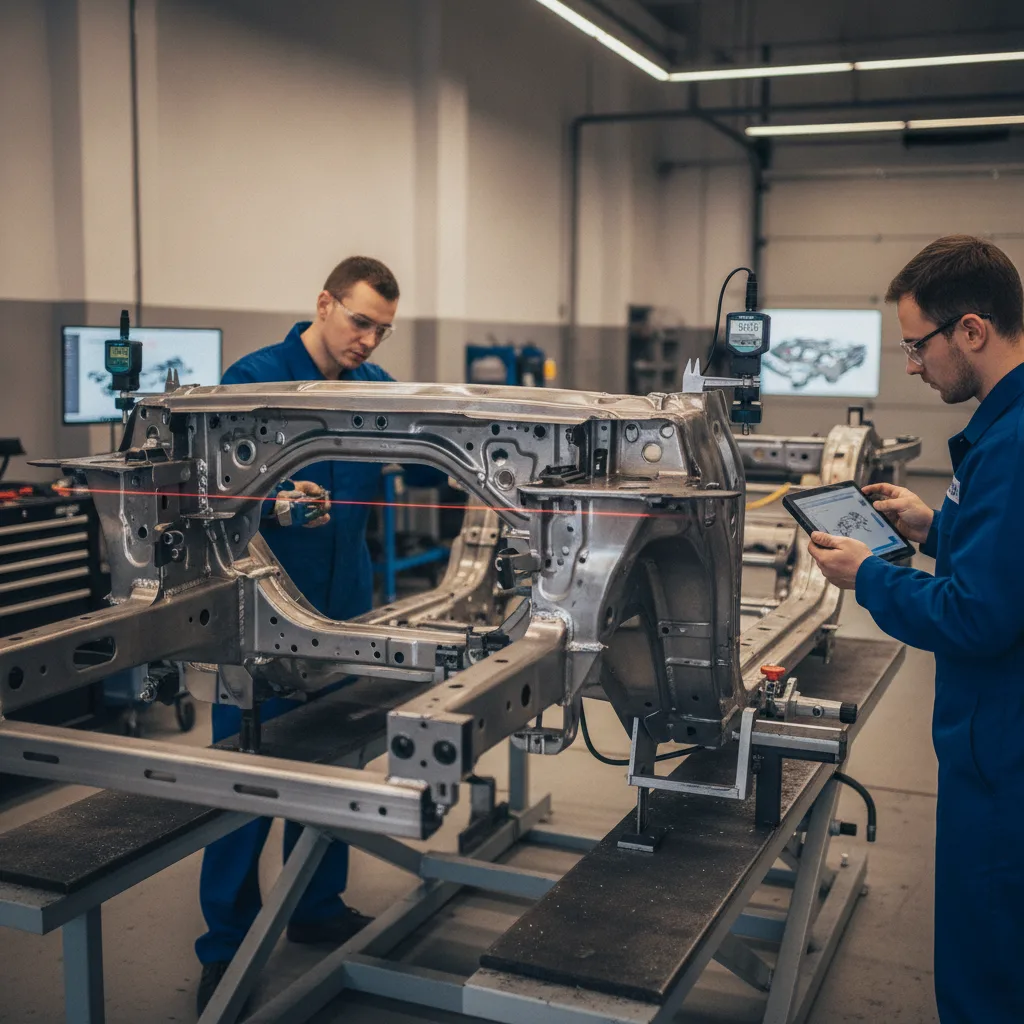
Visual inspection only gets you so far. The real diagnostic work happens when we put the vehicle on our computerized measuring system. This technology maps the vehicle’s actual dimensions against manufacturer specifications, identifying deviations that would be impossible to detect by eye alone. Even a quarter-inch of frame misalignment can affect steering pull, tire wear, and how your safety systems perform in a future impact.
We cross-reference measurements at multiple points across the vehicle, not just at the obvious damage site. Collision force travels. A front-end hit can compromise the mid-rail or rocker panel on the opposite side of the car. Checking only the point of impact is one of the most common diagnostic mistakes in this industry, and it’s one we don’t make.
ADAS and Sensor Considerations
Modern vehicles add another layer to this process. If your car has lane assist, automatic emergency braking, or adaptive cruise control, those systems rely on sensors that must be precisely positioned relative to the vehicle’s frame. Frame misalignment throws those calibrations off. NHTSA guidance on advanced driver assistance systems makes clear that recalibration after structural repairs isn’t optional. It’s a safety requirement.
Once our diagnostic is complete, we walk you through every finding before work begins. You’ll see the measurements, understand what’s out of spec, and know exactly what the frame alignment repair involves. To schedule your assessment, contact us directly or visit our shop, where walk-ins are always welcome.
Frame Straightening Techniques: From Traditional to Advanced
Older shops used to pull bent frames by feel. A technician would eyeball the damage, hook up chains, apply hydraulic pressure, and call it close enough. For vehicles built in the 1970s and early 1980s, that approach sometimes worked. It doesn’t cut it anymore.
Modern vehicle structures are engineered with precise tolerances measured in millimeters. A frame alignment that’s off by even two or three millimeters can throw off suspension geometry, tire wear, and the deployment timing of airbags. The margin for error is essentially zero.
How Hydraulic Pulling Systems Work
Hydraulic pulling equipment anchors the vehicle to a frame rack, then applies controlled directional force to push or pull distorted metal back toward factory specifications. The equipment itself isn’t new. What’s changed is how technicians measure progress during the pull.
Guessing is gone. Real-time data is in.
At Brad’s Deer Valley Collision, we’ve been doing this work in Phoenix since 1985, and the biggest shift we’ve seen over four decades isn’t the pulling equipment itself. It’s the measuring systems that run alongside it.
Laser Measuring and Computer-Guided Alignment
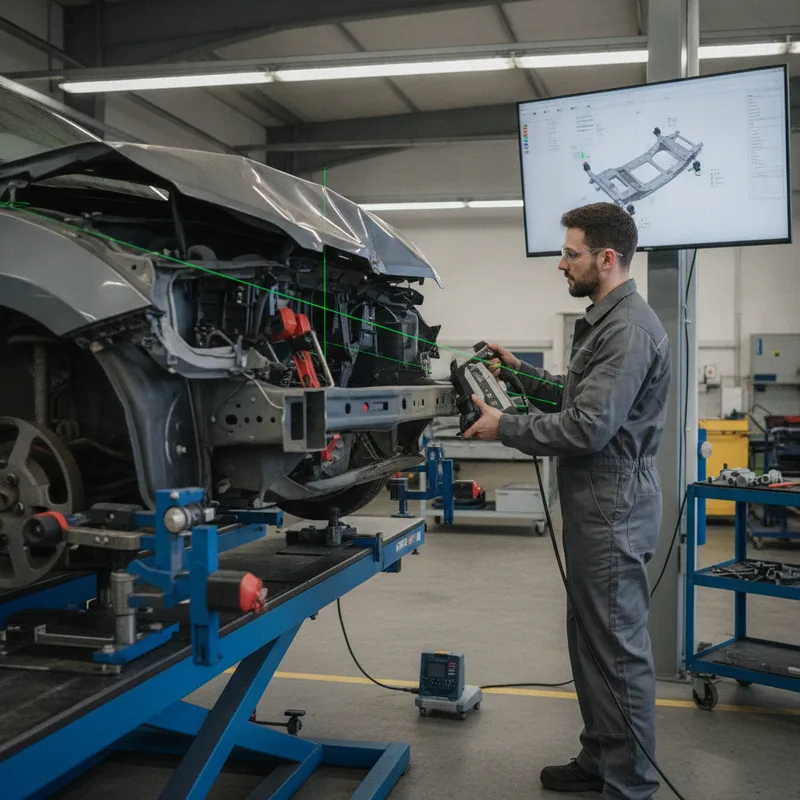
Laser measuring systems attach directly to the vehicle’s datum points and feed live readings to a monitor as technicians work. The software compares those readings against manufacturer specifications for that exact make, model, and year. There’s no interpretation involved. The numbers either match or they don’t.
Computer-guided frame alignment takes this further by mapping the full three-dimensional geometry of the vehicle’s structure. Technicians can see which pull corrects one measurement while potentially affecting another, and adjust accordingly. It’s a feedback loop that manual methods never had.
Some shops present laser measuring as a premium add-on. We’d push back on that framing. It’s not an upgrade. It’s the baseline for doing the job correctly on any vehicle built in the last twenty years, and Phoenix drivers deserve that standard without having to ask for it.
If your vehicle needs structural work after a collision, our full list of services covers everything from initial diagnosis through final alignment verification. You’re also welcome to reach out directly to schedule an assessment or get a written estimate before committing to anything.
Common Frame Damage Mistakes—And How We Avoid Them
Most frame repairs that fail don’t fail because of bad equipment. They fail because of skipped steps. After nearly 40 years working on collision-damaged vehicles in Phoenix, AZ, we’ve seen the same shortcuts cause the same problems over and over.
Here’s the one that surprises people most: a lot of shops complete a frame straightening job and never recheck alignment afterward. They pull the frame back to spec, confirm the measurements look right on the machine, and send the car out. But frame alignment isn’t just about the frame itself. The suspension geometry shifts during a collision, and if nobody verifies the four-wheel alignment after the structural repair, you’re putting a customer back on the road with a vehicle that pulls, wears tires unevenly, and handles unpredictably.
We don’t consider a frame repair finished until the alignment check is done. Full stop.
A second common mistake is missing hidden damage. The impact point is obvious. What’s less obvious is how force traveled through the unibody or frame rails to areas that look untouched. Shops focused on speed skip the full structural scan and only fix what’s visible. That leaves compromised metal in place, which becomes a serious problem in any future collision.
The third mistake is one the industry still doesn’t talk about enough: skipping ADAS recalibration. If your vehicle has lane departure warning, automatic emergency braking, or adaptive cruise control, those systems depend on cameras and sensors that are calibrated to your vehicle’s exact geometry. A frame repair changes that geometry. Skipping recalibration means those safety systems won’t perform correctly, even if the frame looks perfect. Most smaller shops in Phoenix, AZ don’t have the equipment to handle this in-house. We do.
You can review our full range of repair services or contact us directly to ask how we handle any of this on your specific vehicle.
Why Insurance Coverage and Written Estimates Matter
Most insurance disputes over frame alignment repairs don’t start with bad faith. They start with a missing piece of paper.
At Brad’s Deer Valley Collision, we work directly with insurance carriers as a trusted repair program provider. That means we handle the documentation, the photo submissions, and the back-and-forth communication so you don’t have to manage it yourself. But even with that support in place, there are things every Phoenix driver should know before the process begins.
Your Right to Choose Your Own Shop
Insurance adjusters sometimes steer customers toward preferred shops on the carrier’s list. Here’s what many drivers don’t realize: you have the legal right to choose your own repair facility in Arizona, regardless of what your insurer recommends. A shop being on a preferred list doesn’t automatically make it the best choice for structural frame work. It means the insurer has a negotiated rate with that shop. Those are different things.
We’d encourage you to read about our certifications and history before making that decision. We’ve been doing this in Phoenix, AZ since 1985, and our I-CAR credentials aren’t a marketing claim. They affect how we actually repair your vehicle.
What a Written Estimate Protects You From
Get it in writing. Always. A verbal quote means nothing if hidden frame damage surfaces mid-repair and the scope changes. A proper written estimate should itemize labor, parts (OEM vs. aftermarket), and any diagnostic fees. It gives you a baseline if the final invoice looks different than expected.
Red flags include vague line items, no warranty language, and unusually low bids. Low bids on frame work usually mean skipped steps, and skipped steps on structural repairs create safety problems down the road.
Ready to get a clear, written collision repair estimate? Contact our team or stop by. We offer walk-in assessments and can review your full range of repair needs the same day.
What to Expect: Timeline and Aftercare for Frame Alignment Repairs
Frame alignment repair isn’t a same-day job. Anyone who tells you otherwise is cutting corners you can’t see.
At Brad’s Deer Valley Collision, the typical timeline runs three to five days for most frame alignment cases, though complex structural damage can extend that. The first day covers full diagnostics and measurement. Actual straightening and alignment work follows, then a post-repair scan to verify ADAS systems like lane assist and automatic emergency braking are reading correctly. Final inspection happens before any vehicle leaves our lot.
Before You Drop Off Your Vehicle
Photograph every inch of existing damage before you hand over the keys. Remove valuables. Confirm you have a written estimate with OEM or aftermarket parts clearly specified, and ask directly about warranty coverage on the frame work. Verbal promises don’t hold up later.
During the Repair
We provide updates throughout the process. You shouldn’t have to call and chase information. If a shop goes quiet after drop-off, that’s a problem worth paying attention to.
Post-Repair Care
Once you pick up your vehicle, pay attention to how it drives over the first few days. Proper frame alignment should eliminate pulling, uneven tire wear, and any steering wheel offset. If something feels off, bring it back immediately. Don’t wait until the next oil change to mention it.
A common misconception is that frame repairs need months of “settling time.” They don’t. If the repair was done correctly using proper I-CAR standards, the vehicle drives right from day one.
Phoenix, AZ drivers can contact us anytime to schedule an assessment or ask questions. Walk-ins are welcome. Our full list of repair services is available online if you want to review everything we handle before you come in.
Frequently Asked Questions
How do I know if my vehicle has frame damage after a collision?
There are a few things to watch for: doors or windows that don’t close properly, uneven gaps between body panels, tires wearing unevenly, or your vehicle pulling to one side while driving. That said, some frame damage isn’t visible at all without the right equipment. At Brad’s Deer Valley Collision in Phoenix, AZ, USA, we use laser measurement systems to catch hidden frame alignment issues that a visual inspection would miss. We offer free assessments, so bring your vehicle in and we’ll give you a straight answer about what’s going on.
How long does frame straightening typically take?
It depends on how much damage we’re dealing with. Minor frame alignment corrections might take three to five days, but if there’s significant structural damage, you could be looking at two to four weeks for a complete repair. We know that’s a long time to be without your vehicle, which is why we offer loaner vehicles and shuttle service to keep things as convenient as possible. We’ll give you a clear timeline upfront so you’re never left guessing.
Will my insurance cover frame alignment and straightening repairs?
In most cases, yes. Frame damage from a collision is typically covered under your collision or comprehensive insurance policy, though the specifics depend on what you’re carrying. Don’t stress about navigating the paperwork yourself. Brad’s Deer Valley Collision works directly with insurance companies and participates in direct repair programs, so we handle the claims documentation on your behalf. We’ve done this hundreds of times and know how to move the process along efficiently.
What’s the difference between frame straightening and frame replacement?
Frame straightening uses hydraulic pulling equipment combined with laser alignment technology to bring a bent or twisted frame back to the manufacturer’s original specifications. Replacement is only necessary when the structural damage is too severe to repair safely. Our technicians at Brad’s Deer Valley Collision evaluate each vehicle individually and recommend whatever solution is safest and most cost-effective for your situation. We’re not going to push you toward a more expensive option if straightening will do the job correctly.
Do you recalibrate safety systems after frame repair?
Yes, always. Modern vehicles have advanced driver assistance systems (ADAS) built in, things like lane-keeping assist, automatic emergency braking, and blind-spot monitoring. After any frame alignment repair, those systems need to be recalibrated to work the way they’re supposed to. A lot of smaller shops in Phoenix, AZ, USA skip this step or don’t have the equipment to do it properly. Brad’s Deer Valley Collision has the advanced tools required for full ADAS recalibration, so your safety features are fully functional before you drive off our lot.
Get Your Frame Checked at Brad’s Deer Valley Collision in Phoenix, AZ, USA
Hidden frame damage can throw off your alignment, wear out your tires, and put you at real risk on the road even when everything looks fine from the outside. At Brad’s Deer Valley Collision, our certified technicians use advanced laser alignment technology to catch what the eye misses and restore your vehicle to the way it was before the accident. Stop by our shop, give us a call, or request a free frame damage assessment and written estimate online today.
We work hard to earn every job, and you can see what our customers are saying on Google before you ever walk through our door.