Auto Body Insurance Claim Support in Phoenix, AZ: How a Body Shop That Works with Insurance Streamlines Your Claim
Auto Body Insurance Claim Support in Phoenix, AZ: How a Body Shop That Works with Insurance Streamlines Your Claim
Why Choosing the Right Body Shop Matters When You File an Insurance Claim
You’re sitting on the shoulder of the I-17 on a Tuesday morning, bumper crumpled, hazards blinking, and your phone already ringing with your insurance company’s first responder line. The adjuster is friendly. They give you a shop name without hesitation. Most drivers in Phoenix just go with it.
That’s the moment the choice gets made, and most people don’t realize they’re making it.
The shop you choose after a collision affects far more than where your car spends the next week. It directly shapes how quickly your claim gets approved, whether hidden damage gets caught and documented, and how much money stays in your pocket when it’s all over. Insurance adjusters work fast. A shop that doesn’t know how to communicate with them, document damage thoroughly, or push back on underpaid estimates will leave real money on the table, and you’ll absorb that gap.
Phoenix sees significant collision volume year-round, driven by heavy commuter traffic, aggressive summer monsoon conditions, and one of the fastest-growing metro populations in the country. That volume means insurers are processing claims constantly, and shops that aren’t integrated into that process slow everything down.
A body shop that works with insurance understands the documentation standards insurers require, knows how to write estimates that hold up to adjuster scrutiny, and has the relationships to resolve disputes without leaving you stuck in the middle. That’s a practical advantage, not a marketing phrase.
Here’s a professional opinion that runs against common advice: don’t just get three estimates and pick the middle one. A low estimate usually means someone skipped something. Shops that underbid often miss frame issues, ignore ADAS recalibration requirements, or cut corners on surface prep. You want an accurate estimate from a shop with the credentials to back it up.
Certifications matter. I-CAR Gold Class recognition and ASE certifications are real indicators of technical competence, not just wall decorations.
At Brad’s Deer Valley Collision, we’ve been doing this work in Phoenix, AZ since 1985. We know how claims move, where they stall, and how to keep your repair on track. Contact us to schedule a free damage assessment before you commit to anything.
What It Means When a Body Shop Works with Insurance: DRP and Beyond
The term gets used a lot, but few people actually know what it means. A body shop that works with insurance can mean different things depending on the shop’s specific relationship with your carrier.
Direct Repair Programs Explained
A Direct Repair Program, or DRP, is a formal agreement between a body shop and an insurance company. The insurer adds the shop to their approved network, and in exchange, the shop agrees to certain pricing structures, repair timelines, and documentation requirements. When your adjuster says “use one of our preferred shops,” they’re pointing you toward DRP participants.
Here’s the part most adjusters won’t spell out clearly. DRP membership benefits the insurance company as much as it benefits the shop. Insurers get predictable costs and faster cycle times. Shops get a steady flow of referrals. That’s a legitimate arrangement, but it means you should ask questions rather than assume the recommended shop was chosen purely for repair quality.
That said, DRP shops aren’t automatically bad. Many certified, well-equipped facilities do participate in these programs. The key is verifying that the shop also meets your standards, not just the insurer’s standards.
What Certifications Actually Signal
Certifications matter here. I-CAR (Inter-Industry Conference on Auto Collision Repair) and ASE (Automotive Service Excellence) credentials indicate that technicians have completed verified training on current repair procedures. A shop displaying those certifications has made a real investment in its people, not just its marketing.
Insurance partnerships also sometimes require shops to use specific estimating software, like CCC ONE or Mitchell, which helps standardize damage appraisals across the network. That standardization speeds up approvals, which is genuinely useful for customers waiting on repairs.
You’re Not Required to Use Their Shop
This one surprises a lot of Phoenix drivers. Under Arizona law, you have the right to choose your own repair facility regardless of what your insurance company recommends. Your insurer can suggest their preferred shops, but they cannot require you to use them as a condition of coverage.
Choosing an independent shop, one that works with insurance without being locked into a single carrier’s network, often means more flexibility in parts choices and repair methods. At Brad’s Deer Valley Collision, we’ve been working directly with insurance companies in Phoenix, AZ since 1985, and we do it on terms that prioritize the repair over the paperwork.
Want to understand what your claim covers before committing? Contact us for a free estimate and a straight answer.
The Insurance Claim Process: Step-by-Step from Damage Assessment to Completion
Most delays in collision repair don’t come from the actual repair work. They come from gaps in communication between the shop, the customer, and the insurance carrier. Here’s what the process actually looks like at a body shop that works with insurance, when it’s run the right way.
Step 1: Initial Damage Assessment
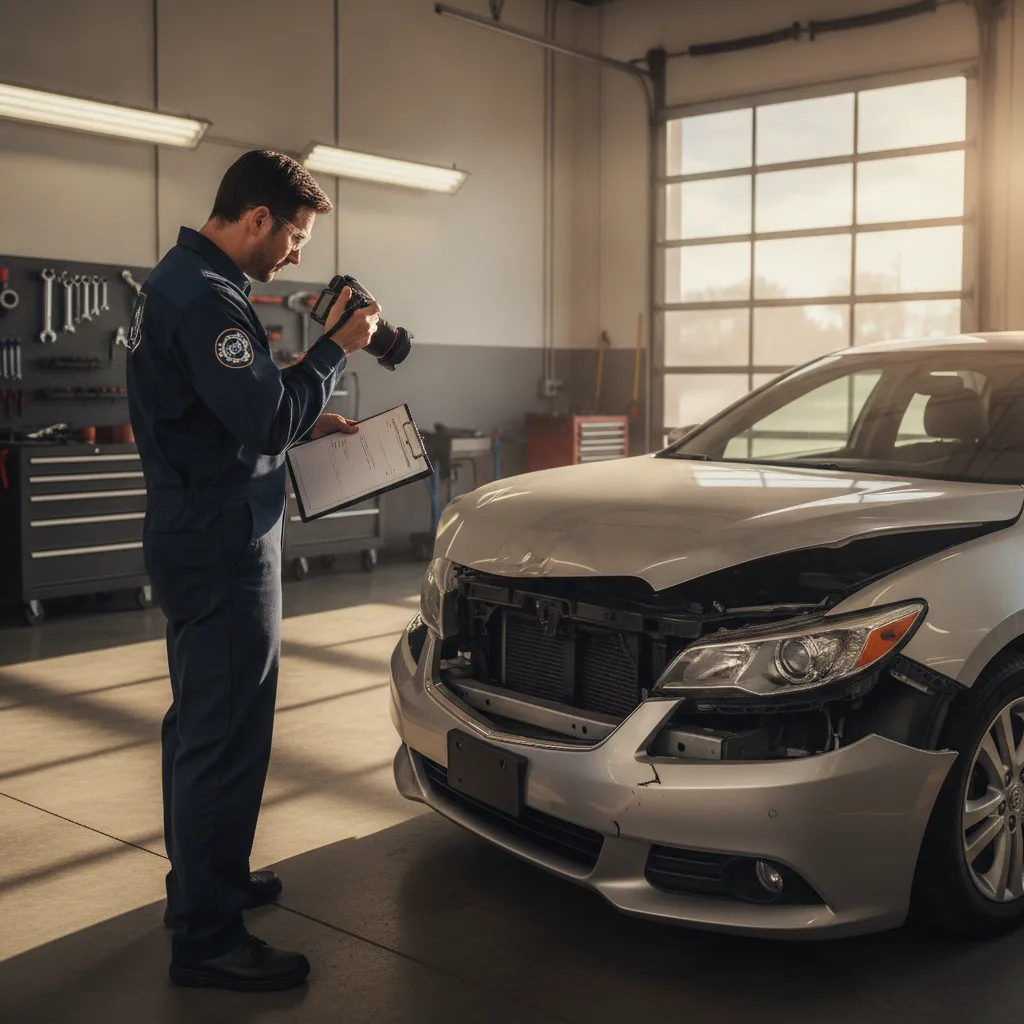
You bring the vehicle in and a technician does a thorough walkthrough, not just a glance at the obvious impact points. Hidden damage matters here. A crumpled bumper cover might be hiding a bent reinforcement bar or compromised mounting brackets underneath. At Brad’s Deer Valley Collision, we’ve been doing this since 1985, and experienced eyes catch things a quick visual won’t. Before anything is touched, photograph your vehicle from every angle. Document pre-existing scratches and dings so there’s no confusion later.
Step 2: Estimate Generation and Insurer Approval
The shop produces a written estimate and submits it to your insurance carrier. This is where working with a shop that has established insurer relationships pays off. Approved shops often have direct lines to adjusters, which cuts approval time significantly. One thing most people don’t realize: you have the legal right to choose your own shop in Arizona regardless of what your insurance company suggests. Your carrier cannot force you into a preferred network shop.
Step 3: Supplement Identification
This step surprises a lot of customers. Once a technician tears down the vehicle, additional damage almost always surfaces. That’s normal, not a red flag. A supplement is filed with the insurer to cover the newly discovered damage. Shops with solid insurer relationships handle this quickly. At shops without those relationships, it can stall the entire job for days.
Step 4: Parts Ordering
Ask whether your repair uses OEM or aftermarket parts. It matters for fit, finish, and resale value. Some insurers push aftermarket to control costs. A good shop will advocate for OEM when it’s appropriate and explain the difference to you directly. Parts availability in the Phoenix, AZ market varies by make and model, and backordered parts are one of the most common causes of repair delays.
Step 5: Repair and Safety System Recalibration
This is where most shops fall short. Modern vehicles have ADAS systems, lane departure warnings, automatic braking, blind spot monitoring, and similar technology that require recalibration after structural or bumper repairs. Skipping this step isn’t just sloppy; it’s dangerous. Confirm your shop has the equipment and certification to handle it. View the full list of services we offer to see how we handle this end-to-end.
Step 6: Final Inspection and Delivery
A proper final inspection covers paint match, panel gaps, structural alignment, and a road test. Walk around the vehicle yourself before signing off. Check panel gaps. Verify the paint match in natural light. Then contact us if you have any questions about what to expect at pickup.
According to the Insurance Information Institute, auto collision claims average several hundred dollars in administrative cost alone when communication breaks down. Choosing an experienced shop that manages the process tightly keeps both the timeline and your costs under control.
Documentation and Evidence: What Your Insurance Company Requires
Get this part wrong and your claim slows to a crawl. Insurance companies settle claims faster when the documentation is clean, consistent, and complete. That’s not an opinion; it’s a pattern we’ve watched play out since 1985 at Brad’s Deer Valley Collision.
Before your vehicle even arrives at our shop, you should have already photographed everything. Take photos at the scene, from multiple angles, in good lighting. Capture the damage, the other vehicle if applicable, the road conditions, and any visible skid marks or debris. Don’t rely on memory or assume the adjuster will document everything thoroughly on your behalf.
Here’s what insurers typically require to process a collision claim:
-
A written, itemized repair estimate from a licensed body shop
-
Dated photographs of all visible damage taken close to the time of the incident
-
A copy of the police or incident report, if one was filed
-
Your own written notes describing what happened, including date, time, and road conditions
-
Any communication records between you and the other party or their insurer
A lot of people are told to let the insurance adjuster handle the documentation. That’s advice worth questioning. Adjusters represent the carrier, not you. Keeping your own parallel record of photos, emails, and written estimates protects your position if there’s a dispute over repair scope or cost.
A body shop that works with insurance directly, like we do here in Phoenix, AZ, can provide the itemized estimates and repair records your carrier needs in the format they expect. That removes a lot of back-and-forth. The Insurance Information Institute recommends keeping copies of all claim-related documents until the repair is fully resolved and the claim is formally closed. We’d extend that timeline further. Keep them indefinitely.
Contact us before your claim gets complicated. Early documentation support makes a real difference.
Common Insurance Claim Mistakes to Avoid in Phoenix
Most claim delays we see aren’t caused by the insurance company. They’re caused by decisions the vehicle owner made in the first 48 hours after the accident.
Here are the mistakes that cost Phoenix drivers the most time and money.
Skipping the photo documentation
Before anything is touched, photograph every angle of the damage, including areas that look fine. Insurers sometimes dispute pre-existing versus accident-related damage. Without dated photos, that argument is hard to win. This takes five minutes and protects you throughout the entire process.
Accepting the first estimate without question
A low estimate isn’t always a deal. It’s often a sign that someone skipped a proper inspection. Hidden frame damage, compromised safety systems, and structural issues don’t always show up on a surface-level walkthrough. Get at least two written estimates from qualified shops before you commit to anything.
Letting the insurance company choose your shop by default
Under Arizona law, you have the right to choose your own repair facility. Your insurer may recommend a preferred shop, and there’s nothing wrong with considering it, but you are not required to use it. A body shop that works with insurance directly, like shops participating in direct repair programs, can process your claim efficiently without being the specific shop your adjuster named.
Failing to ask about OEM versus aftermarket parts
This question matters more than most people realize. Aftermarket parts can affect fit, finish, and in some cases, safety system performance. Ask your shop explicitly what parts are being used and whether your policy covers OEM components. Don’t assume.
Choosing a shop without checking credentials
Certifications like I-CAR and ASE aren’t just wall decorations. They indicate that technicians have completed structured, current training. A shop without visible credentials is a risk you don’t need to take, especially in a city as large as Phoenix, AZ, where qualified options exist.
One opinion worth stating plainly: the common advice to “just go with whoever your insurer recommends” oversimplifies your actual options. You can work with a qualified, experienced shop, get direct insurance billing, and still choose based on credentials and trust. Those things aren’t mutually exclusive. Brad’s Deer Valley Collision has navigated these conversations with Phoenix drivers since 1985. Reach out before you commit to anything.
How Brad’s Deer Valley Collision Streamlines Your Insurance Claim
We’ve been doing this since 1985. That’s four decades of working directly with insurance adjusters, documenting damage, writing accurate estimates, and getting Phoenix drivers back on the road without the runaround.
At Brad’s Deer Valley Collision, being a body shop that works with insurance isn’t a marketing line. It’s how our operation is built. Our I-CAR and ASE certified technicians handle the back-and-forth with your carrier so you’re not stuck playing middleman between your adjuster and the repair bay.
Here’s what that looks like practically:
-
We write a thorough estimate upfront and submit it with complete documentation.
-
We flag hidden damage early so there are no surprise supplements that drag out your timeline.
-
We recalibrate ADAS safety systems after structural repairs, which many Phoenix shops skip entirely.
-
We keep you updated throughout the process, not just when your car is ready.
A lot of shops treat the estimate as a formality. We treat it as your claim’s foundation. A weak estimate at the start is the single biggest cause of delayed settlements, and we’ve watched that pattern repeat too many times to cut corners on it.
We also offer loaner vehicles and shuttle service, because your life doesn’t stop while your car is in our bay.
You’re always welcome to walk in. Our shop is here in Phoenix, AZ, and we’re ready to assess your damage, answer your questions, and get the process moving. Contact us today or browse our full repair services to see what we can do for you.
Frequently Asked Questions
Can I choose my own body shop if my insurance company recommends a different one?
Yes, you absolutely can. In Phoenix, AZ, USA, you have the legal right to take your vehicle to any licensed body shop, regardless of which shop your insurer suggests. Insurance companies often push their preferred network shops, but that recommendation isn’t a requirement.
That said, choosing a body shop that works with insurance directly does make the whole process smoother. We handle the back-and-forth with adjusters every day, so approvals move faster and there’s less hassle on your end. You get to make the call, and we’re here to support it.
What does it mean when a body shop is on an insurance company’s direct repair program (DRP)?
A direct repair program, or DRP, is a formal agreement between a body shop and an insurance company. The shop agrees to follow specific repair standards and turnaround timelines, and in return, the insurer sends referrals their way.
For you, this means faster claim processing, clearer communication between the shop and your insurer, and a higher standard of quality control built into the process. At Brad’s Deer Valley Collision in Phoenix, AZ, USA, being a body shop that works with insurance means we already know what your insurer needs, so there are fewer delays and surprises from start to finish.
How long does an insurance claim typically take at a body shop that works with insurance?
It really depends on the extent of the damage. Straightforward repairs can be done in 2 to 5 business days. If the damage is more severe or parts need to be ordered, you’re looking at 2 to 4 weeks in some cases.
Working with a body shop that works with insurance speeds things up because we know how to submit documentation correctly the first time and communicate directly with adjusters. Parts availability and your insurer’s response time are usually the biggest factors in the timeline. We keep you updated throughout so you always know where things stand.
What documentation do I need to provide when filing a collision claim?
You’ll want to gather a few key things: photos of all visible damage, your insurance policy information and claim number, the police or accident report if one was filed, a written repair estimate, and contact details for any other drivers or parties involved.
The good news is that when you bring your vehicle to us here in Phoenix, AZ, USA, our team helps organize and submit a lot of this on your behalf. We work with your insurer directly, so you don’t have to figure out what format they need or which details matter most. We’ve done this countless times and know how to make it straightforward.
Will the body shop use OEM or aftermarket parts for my repair?
Most insurance policies cover both OEM (original equipment manufacturer) and aftermarket parts, but your repair estimate will spell out exactly which ones are being used. OEM parts are made by your vehicle’s manufacturer and match the original specs exactly. Aftermarket parts come from third-party manufacturers and are often perfectly acceptable, though fit and longevity can vary depending on the brand.
Our advice is to ask upfront, both at the shop and with your insurer. At Brad’s Deer Valley Collision, we’re transparent about which parts go into your vehicle and why. Don’t hesitate to stop by or give us a call if you have questions before approving any estimate.
Let Brad’s Deer Valley Collision Handle Your Insurance Claim
If you’ve been in an accident anywhere in Phoenix, AZ, USA, you shouldn’t have to fight with insurance companies on your own. We work directly with insurers to get your claim processed smoothly and your repairs done right, starting with a free, comprehensive damage assessment from our certified technicians. Stop by our Deer Valley location, give us a call, or see what our customers are saying on Google and find out why so many Phoenix drivers trust us to handle everything.
Contact Brad’s Deer Valley Collision today and let’s get you back on the road.