Auto Frame Repair in Phoenix, AZ: Restoring Safety After Structural Damage
Auto Frame Repair in Phoenix, AZ: Restoring Safety After Structural Damage
Why Professional Frame Repair Matters After a Collision
Auto frame repair matters because a vehicle’s frame is the structural backbone that keeps every panel, safety system, and wheel aligned; when it’s bent or misaligned after a crash, the car can’t protect its occupants the way engineers designed it to. Brad’s Deer Valley Collision provides auto frame repair for drivers in Phoenix, AZ, USA, using alignment equipment built to restore factory specifications. Brad’s Deer Valley Collision has operated since 1985.
Picture a driver on the I-17 who gets rear-ended hard enough to crumple the trunk but walks away thinking the damage is cosmetic. Underneath, the rear frame rail may have shifted just enough to throw off suspension geometry. That kind of hidden damage is common, and it’s exactly why a visual inspection alone often isn’t enough.
Left unaddressed, frame damage creates real consequences. Tires wear unevenly. Handling gets unpredictable at highway speeds. Airbags and seatbelts, which rely on precise structural measurements to deploy correctly, may not perform the way they’re supposed to in a future collision. A car with a compromised frame can also fail to distribute crash forces properly, putting more stress on the passenger cabin.
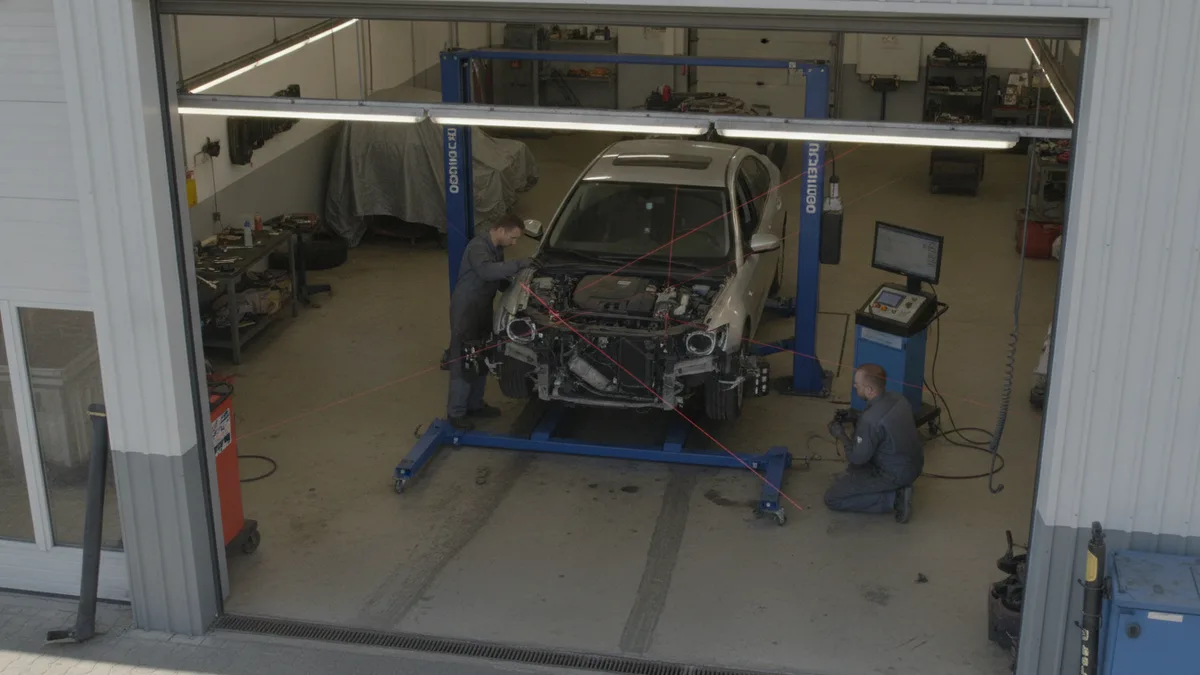
Modern alignment technology changes what’s possible here. Computerized measuring systems compare a damaged frame against the manufacturer’s original specifications down to the millimeter, then guide technicians as they pull and reshape the structure back into tolerance. In our experience, this is where a lot of shops cut corners; they eyeball alignment instead of measuring it, and that shortcut is hard to spot until something feels off months later.
Frame integrity isn’t something to guess about. Anyone unsure whether their vehicle has structural damage should have it inspected by a qualified technician before driving it regularly. Drivers researching options can review the full range of structural and cosmetic capabilities on the collision and frame repair services page to understand what a proper inspection and repair process involves.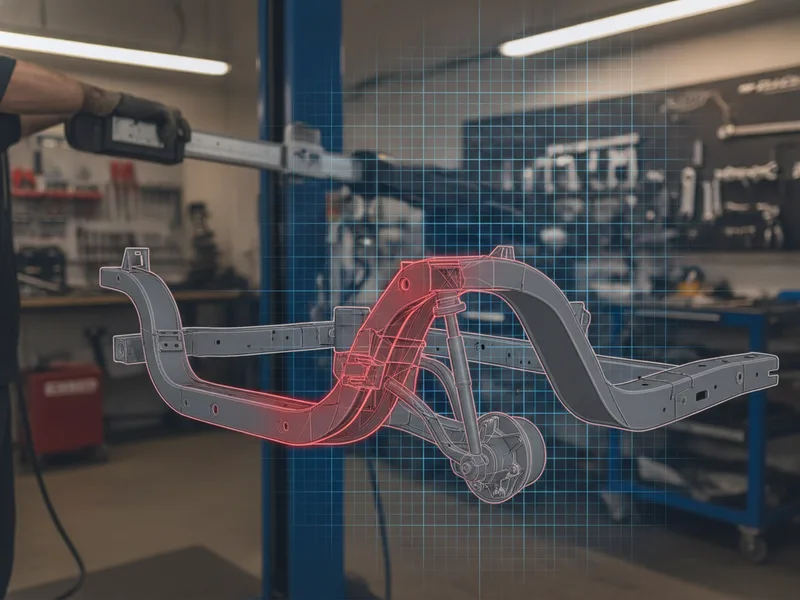
Signs Your Vehicle Needs Frame Repair
Frame damage doesn’t always announce itself with crumpled metal. Some of the worst structural problems hide under a car that still looks driveable.
The most common tip-off is a vehicle that pulls to one side while driving straight, even on flat road. That’s often a sign the frame or unibody has shifted out of alignment, throwing off the suspension geometry. Uneven or rapid tire wear on one side points to the same issue. Doors, hood, or trunk lids that suddenly stop closing flush, or that require extra effort to latch, usually mean the body opening around them has racked slightly out of square.
Other warning signs include:
- Gaps between panels that look wider or uneven compared to before the collision
- A steering wheel that sits off-center when the wheels are straight
- New rattles, clunks, or vibration at highway speed
- Visible wrinkling, kinks, or paint cracking near the frame rails or firewall
Here’s an opinion many Phoenix, AZ, USA drivers don’t hear often enough: a clean-looking bumper after a low-speed impact doesn’t rule out frame damage. We’ve seen plenty of vehicles with barely a scratch up front that had measurable frame shift once we put them on the alignment rack. Bumpers are designed to absorb impact and sometimes take the hit so the frame doesn’t, but not always.
If you notice any of these signs, a proper inspection matters more than guessing. Auto frame repair starts with an accurate diagnosis, not assumptions based on cosmetic appearance alone.
How Frame Alignment Technology Restores Factory Specifications
Pull into any shop still eyeballing frame damage with a tape measure and a chalk line, and you’re looking at guesswork dressed up as repair. Modern auto frame repair doesn’t work that way anymore. The equipment changed the trade, and the shops that invested in it can catch problems a visual inspection misses entirely.
Every repair starts with measurement, not pulling. Technicians mount the vehicle on a computerized alignment rack and attach laser or ultrasonic sensors to specific points on the frame. Those points aren’t guesses; they come from OEM specification databases that tell a technician exactly where each mounting point, crossmember, and control arm bracket should sit on that particular make and model. The computer compares live readings against factory data and shows the deviation in millimeters.
Once the damage is mapped, hydraulic pulling towers anchor to the frame and apply controlled force in the direction needed to bring it back toward spec. This isn’t a single yank. Technicians pull in stages, checking the laser readings between each pull, because metal that gets forced back too fast can develop stress fractures or spring past the target and overcorrect.
Here’s where we’d push back on a common assumption. A lot of drivers think a frame either “passes” or “fails” a straightness check, like a pass/fail test. In practice, the tolerances are more nuanced than that, and a shop working with real OEM data can often bring a frame within acceptable range even when the initial damage looks severe. The measurement system is what makes that judgment call defensible instead of a guess.
Why the Equipment Investment Matters
Not every shop runs this kind of setup. Laser measuring systems and computer-guided racks cost real money, and smaller operations sometimes skip them in favor of manual methods. Brad’s Deer Valley Collision has built its frame repair process around this technology, and we’d encourage any Phoenix, AZ, USA driver getting an estimate elsewhere to ask directly whether the shop uses computerized measurement or relies on visual checks alone.
Frame work also touches ADAS calibration. Cameras and sensors mounted to the frame or bumper depend on precise geometry, and a frame that’s off by even a small margin can throw those systems out of alignment. The National Highway Traffic Safety Administration outlines general guidance on structural safety systems, and it’s worth reviewing if you want a broader technical grounding on why this precision matters.
A licensed technician can walk you through your vehicle’s specific measurements and explain what the readings mean for your car.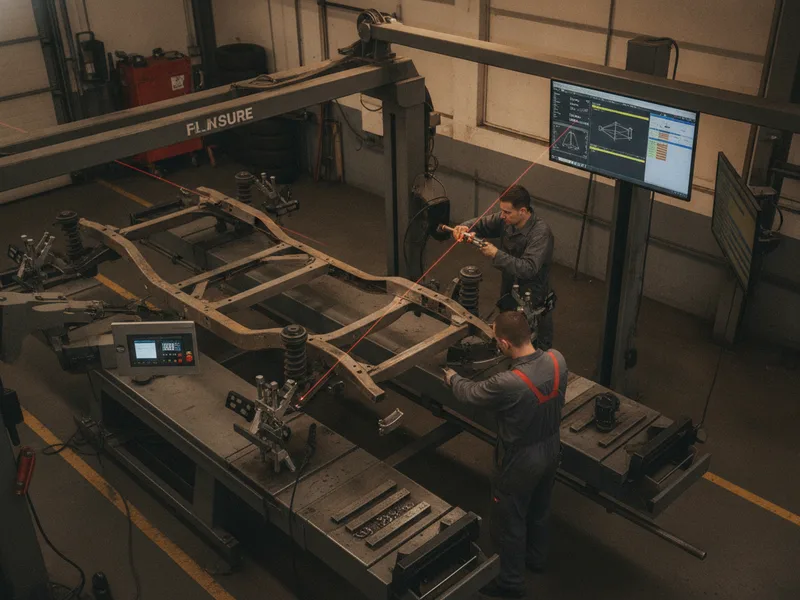
Common Frame Damage Scenarios and What They Require
Not every crash bends metal the same way. The point of impact, the speed, and the vehicle’s construction all determine what kind of auto frame repair a car actually needs, and lumping every job into one category is where a lot of shops cut corners.
Head-On Collisions
Front-end impacts usually push the frame rails backward and upward, sometimes compressing the crumple zones into the firewall area. This often affects radiator support, front strut towers, and engine mount positioning. Straightening equipment has to pull in multiple directions at once, not just backward, because the metal deforms in a curve rather than a straight line.
Side-Impact Damage
T-bone collisions push a frame sideways rather than lengthwise, and that lateral force tends to twist the unibody instead of just bending it. Door pillars, rocker panels, and the center floor pan often need attention alongside the frame rails themselves. In our experience, side-impact jobs get misjudged more often than head-on collisions because the exterior damage looks contained, while the twist underneath extends much further than it appears.
Rear-End Collisions
Lower-speed rear impacts often look minor from the outside but can still shift trunk floor structure or rear rail alignment. Higher-speed rear hits behave more like reversed head-on damage, compressing structure toward the passenger compartment.
Rollover Damage
Rollovers are the hardest scenario to assess without proper equipment, since the roof, pillars, and frame can all sustain damage simultaneously from different angles. This is where full structural restoration, not just spot straightening, tends to be necessary.
Every one of these scenarios calls for a different combination of pulling, sectioning, and measurement against factory specifications. For Phoenix, AZ, USA drivers trying to figure out what their own vehicle needs, a hands-on inspection matters more than guessing from the outside. Anyone dealing with a legal or insurance dispute over the extent of damage should also confirm details with a qualified claims professional before signing off on repairs. Customers ready to get a firsthand look at their vehicle’s damage can request a written assessment through the contact page for scheduling a repair evaluation.
Frame Repair vs. Frame Replacement: When and Why Each Applies
Ask five body shops whether a bent frame can be saved, and you might get five different answers. That’s not because the science is unclear. It’s because the decision depends on how much the metal stretched, where the damage sits, and whether the manufacturer allows repair on that section at all.
Straightening works when the frame rail bent but the metal didn’t crack, tear, or stretch past its yield point. A hydraulic pulling system can bring the rail back to factory measurements, and the repaired section holds its strength the way it did before the collision. Most auto frame repair jobs in Phoenix, AZ, USA fall into this category, especially with moderate front or rear impacts where the crumple zone did its job.
Replacement becomes the safer call in a few specific situations.
- The frame rail is torn, cracked, or kinked sharply rather than bent in a smooth curve
- Metal has stretched beyond what the manufacturer’s repair tolerances allow
- Damage sits near a critical mounting point for the engine, suspension, or safety cage
- Multiple impact points have weakened the rail in more than one spot
Here’s a point of disagreement we run into often: some shops default to full-frame replacement whenever they see any stretching, partly because it’s a bigger job and partly out of caution. In our experience, that’s not always necessary. Precise measurement against factory specs, not guesswork, should drive the call. A rail that measures within tolerance after pulling doesn’t need replacing just because it looked bad on the lift.
Manufacturer repair guidelines, which vary by make and model, ultimately set the boundary between what can be pulled and what has to be cut out. A qualified technician should always confirm those specs before finalizing an estimate, since guessing on structural decisions carries real safety consequences.
What to Expect During the Frame Repair Process at Brad’s Deer Valley
Walk into our shop with a damaged vehicle, and the first thing that happens isn’t a wrench touching metal. It’s measurement. We put the car on the frame rack and pull baseline readings against factory specifications before deciding on any repair approach. Skipping this step is how shops end up guessing, and guessing on auto frame repair leads to comebacks.
Once we know exactly where the frame sits relative to factory tolerances, we map out the pulls. Hydraulic rams apply controlled tension to bring the rail back into position, and we recheck measurements throughout, not just at the end. Some shops only measure before and after. In our experience, that misses damage that shifts mid-pull, so we check at intervals instead.
Welding comes next if any sectioning or panel replacement is required. This has to match the original manufacturer’s specs for joint type and strength, not just look clean on the surface.
Communication Along the Way
Phoenix customers dropping off a vehicle deserve to know what’s happening to it. We provide updates as work progresses, including photos when there’s something worth showing. Nobody should have to call a shop repeatedly just to find out if their car is still on the rack.
Final Verification
Before any vehicle leaves, it goes through a final measurement check to confirm the frame matches factory tolerances. If the car has advanced driver assistance systems, ADAS recalibration happens here too, since a straightened frame doesn’t guarantee those sensors are still aimed correctly.
Turnaround time depends on the extent of damage, parts availability, and whether ADAS recalibration is involved, so any estimate should come with an acknowledgment that timelines can shift. Customers are welcome to stop by our Phoenix, AZ, USA location and see the equipment firsthand before committing to a repair. A qualified technician can walk through the specifics of what a given vehicle needs.
Insurance Coverage and Frame Repair Estimates in Phoenix
Every adjuster writes the first estimate a little differently. That’s normal. Frame damage often hides behind bumpers and fenders, so an initial insurance estimate frequently changes once a shop opens the vehicle and measures it on a frame rack.
Structural repairs are typically covered under collision coverage, though the specifics depend on the policy. A licensed insurance agent or the adjuster assigned to the claim can confirm what a particular policy covers before work begins.
Here’s what most Phoenix drivers don’t realize: insurers can suggest a shop, but they can’t require you to use one. Arizona drivers have the right to choose their own repair shop, regardless of which facility appears on an insurer’s preferred list. That right matters more with frame work than with cosmetic repairs, since precision and documentation affect how well the vehicle performs afterward.
We participate in direct repair programs with several insurers, which speeds up approval on many claims. We also write estimates for customers whose insurance company suggests a different shop. Either way, we document measurements, parts, and labor thoroughly enough that adjusters can review the file quickly.
Our background and certification details are available for anyone comparing shops or verifying credentials before authorizing frame work. Getting two or three written estimates is worth the extra day it takes.
Frequently Asked Questions
How long does frame repair typically take?
Auto frame repair timelines depend on how bad the damage is. Minor straightening jobs might take 3 to 7 days. If the frame took a hard hit and needs more extensive structural work, you’re looking at something closer to 2 to 4 weeks. At Brad’s Deer Valley Collision in Phoenix, AZ, we look at your vehicle first and give you a realistic estimate before any work starts, and we’ll keep you posted if anything changes along the way.
What is the difference between unibody and body-frame construction, and does it affect repair?
Unibody construction means the frame and body are built as one connected structure, which is common on most cars and smaller SUVs today. Traditional body-on-frame vehicles, like many trucks, have a separate frame bolted underneath the body. Both types need professional alignment equipment for a proper fix, but unibody vehicles need extra precise laser measurement since every part of that structure is holding weight and keeping things stable.
Will my vehicle be safe to drive after frame repair?
A vehicle that’s gone through proper auto frame repair should drive the way it did before the damage happened. We use laser alignment technology and run a full inspection before handing the keys back, checking that everything matches factory specs. That said, if you ever have concerns about how your car feels after a repair, it’s worth bringing it back in or having a qualified mechanic take a look.
Can I drive my vehicle if it has frame damage but hasn’t been repaired yet?
Driving with unrepaired frame damage isn’t a good idea. A damaged frame can throw off handling, mess with braking, and even affect whether your airbags deploy correctly in another collision. If you’ve been in an accident in Phoenix, AZ and suspect your frame took damage, it’s best to get it looked at right away rather than waiting. Bring it by Brad’s Deer Valley Collision and we’ll check things out before you put more miles on it.
Not Sure If Your Frame Took a Hit?
A bent or misaligned frame isn’t always obvious from the outside, and driving on one can affect how your vehicle handles down the road. If your car’s been in an accident and something feels off, or you just want a second opinion, bring it by Brad’s Deer Valley Collision in Phoenix, AZ. Our certified technicians will check the structure, walk you through what they find, and put it in writing so you know exactly where things stand.
Stop by our shop or give us a call to set up a free assessment. You can also look at our full collision and frame alignment services to see how we handle repairs from start to finish. For questions involving insurance claims or your vehicle’s long-term safety, it’s always worth checking with your insurer or a qualified mechanic too. Want to know what neighbors think first? Check out our reviews on Google.